

Everything posted by Noz
-
Ah, I see now.
-
So the pump isn't priming with ignition. If you can't hear it prime, and the gauge is reading zero, then there's no fuel pressure in the lines. If it initially primes on cranking, it will indeed take a few turns to fire. Disconnected O2 sensors will have nothing to do with starting issues. They will have been disconnected by someone because they were believed not to be working.
-
So the pump isn't priming with ignition. If you can't hear it prime, and the gauge is reading zero, then there's no fuel pressure in the lines. If it initially primes on cranking, it will indeed take a few turns to fire. Disconnected O2 sensors will have nothing to do with starting issues. They will have been disconnected by someone because they were believed not to be working.
-
I've yet to come across an engine issue that Nistune is unable to diagnose, be it via the active tests or monitoring realtime values :laugh: Full Conzult is €139 for the software only, I personally wouldn't say it's worth it in addition to the Nistune software.
-
I've yet to come across an engine issue that Nistune is unable to diagnose, be it via the active tests or monitoring realtime values :laugh: Full Conzult is €139 for the software only, I personally wouldn't say it's worth it in addition to the Nistune software.
-
Or..... Running it on a dyno will tell you exactly what you need to know: Specifically, what AFR it is running throughout, and the level of knock as monitored by a professional. Just get a Nistune board in your ECU plus a wideband AFR guage and I can map it remotely based on the logs you take :cool3:
-
Or..... Running it on a dyno will tell you exactly what you need to know: Specifically, what AFR it is running throughout, and the level of knock as monitored by a professional. Just get a Nistune board in your ECU plus a wideband AFR guage and I can map it remotely based on the logs you take :cool3:
-
1) - 3) Spot on 4) I'm not sure about this. I could investigate by switching the knock sensor output normally whilst driving or on the dyno, but it's not something I have ever thought of investigating. I can hazard a guess, and due to knock hysteresis (it takes a larger reduction in timing to halt detonation than to prevent it in the first place) I *think* the ECU will use the knock maps until the car is switched off and on again. I know that when I had one car that was using the knock maps, once I had deleted the knock DTC and also forced the ECU to ignore knock DTC, I had to switch off & on again for the ECU to be using the regular maps. 5) & 6) Nistune will highlight the maps & tables that the ECU is accessing, so will show exactly when a Zed is using the knock maps. High gear maps: These are something I disable. There is a coefficient for when the high gear maps are used, when mapping I see them accessed all the time. The main difference is the removal of O2 feedback in part of the map. The JWT map uses the high gear fuelling for 90% of its 'tuned' fuelling map.
-
1) - 3) Spot on 4) I'm not sure about this. I could investigate by switching the knock sensor output normally whilst driving or on the dyno, but it's not something I have ever thought of investigating. I can hazard a guess, and due to knock hysteresis (it takes a larger reduction in timing to halt detonation than to prevent it in the first place) I *think* the ECU will use the knock maps until the car is switched off and on again. I know that when I had one car that was using the knock maps, once I had deleted the knock DTC and also forced the ECU to ignore knock DTC, I had to switch off & on again for the ECU to be using the regular maps. 5) & 6) Nistune will highlight the maps & tables that the ECU is accessing, so will show exactly when a Zed is using the knock maps. High gear maps: These are something I disable. There is a coefficient for when the high gear maps are used, when mapping I see them accessed all the time. The main difference is the removal of O2 feedback in part of the map. The JWT map uses the high gear fuelling for 90% of its 'tuned' fuelling map.
-
Can't help you, but I loved my MK3 V6. Tuned it with ST24 parts and it would do 33mpg on a long run. Was great until the box let go for no apparent reason, other than it was quite a steep hill I was on at the time. Actually smashed a hole in the casing. Still drove fine though! Glas it was a freebie :D
-
Can't help you, but I loved my MK3 V6. Tuned it with ST24 parts and it would do 33mpg on a long run. Was great until the box let go for no apparent reason, other than it was quite a steep hill I was on at the time. Actually smashed a hole in the casing. Still drove fine though! Glas it was a freebie :D
-
No need to buy anything else if you're getting Nistune. I typically keep them in stock, so give me a shout if you need any information :)
-
Yup, it's a PowerZed/Turbonoz weekend of mapping, starting with yours :)
-
Nope, it's the solenoids that are typically bypassed with a boost controller. IMO, the knock sensor becomes redundant the moment an owner decides to modify his car or at least realise the difference between running on VPower & Asda 95. It is indeed possible, it could activate an external LED/buzzer as well as the solenoids if requied. The knock sensor actually acts as a trigger for the ECU to access 3 different maps (there is also a High Gear map). You could hook up a simple switch to access the knock maps, but think of them as secondary maps instead. This would replace the knock sensor input. A viable upgrade to the knock sensor whilst retaining the stock ECU would be to use an aftermarket knock analyzer with a simple high/low output to trigger the knock maps. I would set up the knock maps to basically stall the engine the moment detonation occurs. This would work, as it will most likely be genuine detonation and not a spurious reporting of engine noise.
-
Unplugging O2 sensors pegs them at 0.31V/0.32V. ECU doesn't run a stock AFR (there's no such thing). Unplugging O2 sensors will simply add a fixed duration to the basic pulsewidth calculated in the main fuelling map, which consists of 256 load sites where fuel is calculated based on load & RPM. So basically it runs richer than 14.7:1 AFR where O2 feedback is activated, which in turn depends on the map you're running, generally idle & cruise (light load). No effect "on boost". But yeah, just unplug 'em. Lots of threads about this if you search :)
-
1) From a mapping point of view: Nistune tells me, it flags which tables are being accessed by the ECU in realtime. From a driver's point of view, boost drops down to the minimum pressure possible (actuator pressure, ~7psi). For EDM ECUs, fuelling in 17 load sites is increased (unchanged at full load & high RPM). Bear in mind that there are 256 load sites. Timing is pulled for a much larger region with the maximum difference being 11°. You would feel the lack of performance. *** The JDM & USDM knock fuel maps are exactly the same as the regular maps, clearly they didn't see it worthwhile adding any fuel to halt det with the reduction in boost. 2) NA Zeds have huge differences between regular & knock maps, and a much larger knock sensing area. You would feel it instantly, power & torque would probably drop by about 25%. *** Looking at this EDM map, there are 16 instances (load sites) where the knock timing is actually higher than the regular timing. I've not noticed this before, it appears to be a genuine error by the Nissan engineers/programmers. They screwed up. Not the only time where the Z32 TT maps are concerned, either ;) There is a reason why you can overboost a Zed and no other Nissan from the same period without appropriate limiter modifications. Ever wonder why there is no mention of fuel cut issues...?Yes, pretty much. It will trigger the ECU to use the knock maps for fuel & timing, and activate the safety boost solenoids. Below is the stock OEM European timing map (already uploaded by myself in another thread elsewhere). The highlighted locations are where knock sensing is active. So fairly high load up to 3200RPM. As is often the case with a 20+yr old Zed, they are a lot more trouble than they're worth. Any knock events above 3200 RPM and it does nothing. Reason for this is that the piezo sensor cannot differntiate between actual knock (6.6kHz for stock 87mm pistons) and engine noise/vibration. A large section of the knock area isn't even accessible by the engine due to boost threshold. It is important to know that Error Code 34 will force the ECU to access the knock maps and safety boost conditions 100% of the time, not just where the knock sensing is activated. It is a "failsafe" that operates a blanket condition. The system is implemented mainly as a safeguard against your average Joe using the wrong grade of fuel. A modified Zed with a suitable map has absolutely no need for the stock system at all, for various reasons not in the scope of this thread.
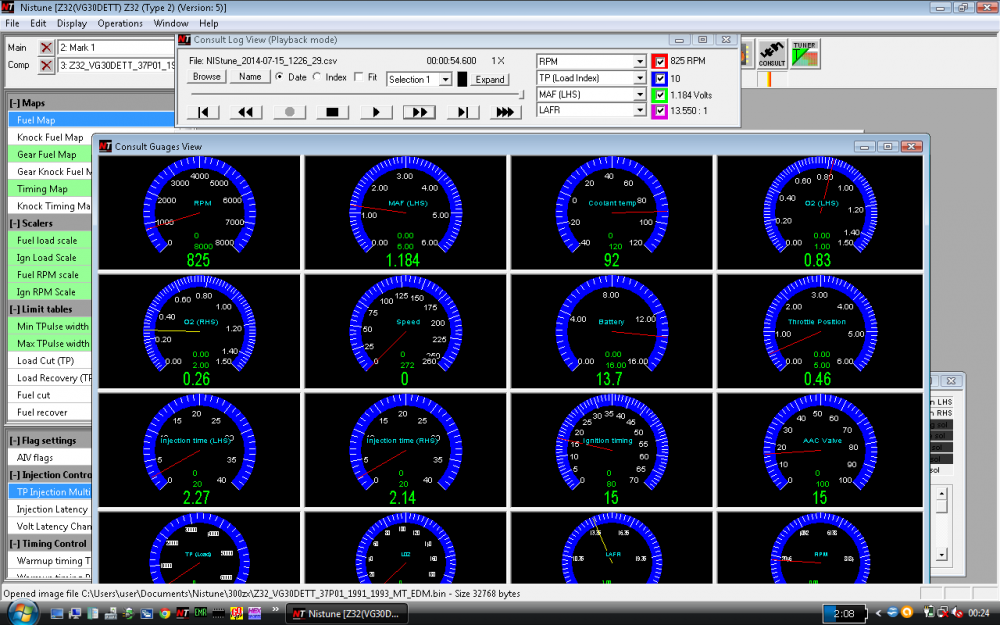
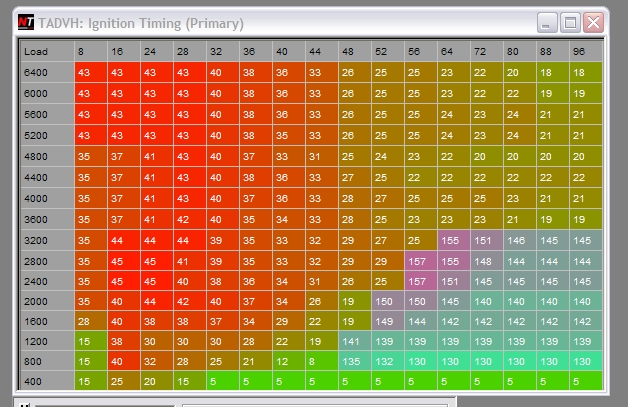 Error code 34 only shows up due to a faulty knock sensor or associated loom. Detonation doesn't trigger a fault code. Open circuit or closed circuit will trigger code 34, 1MΩ resistor replicates a knock sensor, don't know how far out of spec before a fault code is triggered.Hello & welcome!You can test the injector solenoids with a 9V battery, some wire and a bit of insulation tape (to keep the wire on the battery terminals). See if they click. Polarity doesn't matter. If they do click, assume they are sound for the time being and investigate the loom, which includes inside the ECU where the injector drivers are located. Electrical connections "seeming fine" is not very conclusive, you need to be 110% sure the connections are sound. Consider investing in a noid light (kits from £7).Get it on 15% before your engine holes a piston! Quick! OK then, major assumption I'm making here is that those values are in a stable condition, say after 1 minute of idling at the very least. If not, the following observations are pretty worthless :D The O2 sensor reading is in %, so 0% is 0v and 100% is 1.5V (1500mV). The switching voltages are at 0.48V (32%, falling) to force the AFR rich (14.7:1) during a rich condition. This is lambda feedback. RH Pulsewidth looks a bit high at 2.23ms hence the 92% & 80% O2 values (plus the "rich" flag of course). I would expect LH pulsewidth to be higher than RH. Air Flow % is typical for idle condition. At idle, the stock map has an estimated pulsewidth of around 1.5ms, interpolated from 4 load/RPM points. But this is overruled by lambda feedback. I see typical values around 1.9ms. Fuel temp at 43° so I would guess the car has been idling with the bonnet down for around 10 mins after getting up to temp, or with the bonnet up for around 15 mins. Ambient temp approximately...... Lol, just kidding! :wack: Below is a Zed at idle with a faulty RHS O2 sensor. You can see that the LHS O2 reading is at 830mv (rich condition, lambda trying to force the AFR lean). The LHS pulsewidth is 2.27ms. However, what I have is a realtime AFR readout, denoted LAFR, showing 13.55:1, which is a rich condition. I would expect your car to be idling around the same AFR at the time that screenshot was taken. Not due to faulty lambdas though. If the O2 sensors were constantly low, the ECU thinks the AFR is less than 14.7:1, and so extra fuel is injected. This is why it's OK to unplug O2 sensors as they sit at 0.31v (which is less than 0.48V) and so the resultant AFR is always going to be richer than 14.7:1. In your case, the lambda sensors are seeing a genuinely rich condition (voltage > 0.53V/35.3%), so the ECU should be pulling fuel by reducing the pulsewidth, then when AFR gets lean enough to reduce the O2 voltage to 0.48V (32%), the ECU will add fuel to try and keep AFR stoich, and so on ad infinitum. You can see now why if they're not stable values, I've written an essay for no reason!
 Ah, so it's loud det. Ok, so working on the assumption it has severe detonation if you're confident you've heard it, how long has it done it for? Any correlation with when the chip & boost jets were fitted? Reduce the base timing and see if it cures the knock. It's far from ideal as it's a blanket reduction in timing, but it's a 5 minute job and will make it safer to drive as well. It could be the MAF under-reading, you need to see what load values the ECU is accessing. Nistune software will do this. I can't remember if the demo version has the realtime capabilities activated. AAC: Car up to temp, all electrical systems off. It's a mechanical adjustment of the AAC screw, diagnostic software for monitoring only. Adjust it so it hits 16%, then adjust a tiny bit further so it *just* drops to 15%. Reason for this is that it can be showing 15%, but be too far open. Rev the car a couple of times and monitor the response to ensure it just drops to 15% every time. More than happy to help where I can :)You have eliminated 3 out of 4 possibilities in your list (engine is cold, bad engine temp sensor, bad detonation sensor). Now, you need to determine if the car is actually knocking or not. To be blunt: Nothing else matters. There is no Nissan manual for this, you need the expertise of someone that tunes cars. Doesn't matter if they've never even seen a Zed before. It will require several high load pulls in order to monitor the effect of heat soak. Put me on a plane and I will sort it for you in about 1hr. I need a holiday. Once you've determined if it is detonating or not, then you can start investigating the cause of the detonation, or the dodgy knock sensor/wiring. You're doing it arse about face as it stands. Forget the fact that it is a 300ZX, that is not important. It is simply a forced-induction internal combustion engine that may or may not be detonating. Forget the manuals, forget Consult/ECUtalk and cute little voltage readouts. How long has this issue been ongoing for? I would be aiming to solve similar issues in about 1hr on a mildly-modified car I have never seen before. Not because I'm anything special, but because I know the correct sequence for diagnosing issues such as this, and use the correct tools. This guy said it best: For future reference to those interested: If you think your car (Zed, or otherwise) may be detonating, have it monitored properly first & foremost before doing anything else.:lol::lol: