


Everything posted by Noz
-
75% for 13.2 psi? That's not right. 0% is will be actuator pressure. 100% is theoretically infinite pressure (IIRC 90% is maximum on the Profec B) Typical set up for 13.2 psi which is very low (relatively-speaking) should be around the 30% mark on a similar set up as yours. Last mildly modified Zed I set up with a Profec B, I think it was 51% for 16psi (stock turbos & actuators)
-
O2 sensors have no bearing on fuelling other than at idle & cruise.
-
I've known all that for a long, long time. I think that would have been a step too far after the "VG30DETT can only handle 370bhp" mythbusting! http://www.sxoc.com/vbb/showthread.php?366339-mhg-or-wire-rung-block&p=4167925&viewfull=1#post4167925 It's scandalous that the companies continue to sell the items they describe as not fit for purpose :censored:
-
Bore wash from cold start fuelling isn't much of an issue on UK ECUs as the O2 sensors are operational from 25°C as opposed to 50°C on JDM ECUs. Cold start fuelling is a 16x1 table of enrichment values decreasing as temp increases. AFR is typically 12.5:1 on immediate startup, just a bit leaner than a car on maximum load.
-
Maybe it is faulty. I've never had issues with them though. What are the settings? Go through them and post the values in order. Only other explanation (without looking further afield than boost controller and assoc. wiring/vac lines) is the car being in safety mode and with the boost solenoids being open. Other than that, it needs investigating/logging to determine what exactly is happening. The richness & low boost indicate safety mode.
-
It's fine to completely remove the solenoids and run the actuator lines directly to a tee which will then go to the output of the MBC. The Zed was a technical masterpiece (AIVs, PRVR, boost solenoids etc etc), a supercar for the masses I guess. But there are a lot of items that are simply not needed. Boost solenoids being one of them. Yes, they keep boost levels down whilst the car is warming up, but anyone with half a brain can do that. Just don't drive it hard :laugh: Aftermarket sensors can be programmed to bypass unwanted frequencies to ensure accuracy of output (they're just bandpass circuits at the end of the day. For info, the knock frequency for a VG30DETT with stock pistons is 6.62kHz (900/πr) ). When I worked with a high-comp SR20DE-T, at low RPM, high load I could induce very mild detonation that my aftermarket knock sensor completely failed to pick up. It was clear as day in my headphones that I had clamped to the knock sensor itself. I'd say that knock monitoring is essential for hard track work where elevated intake temps can induce detonation. Anything running high boost pressure as well, in case something begins to go awry and you need to come off the gas immediately. You don't typically need a knock sensor to work throught the rev range, detonation is more an issue at peak torque than higher up, which is going to be masked by increasingly loud valve train noise. I look after a high-powered Z32 (613bhp, maxing out the single stock MAF over 5v) and that runs an aftermarket knock sensor. When I map the car, there is a constant code 34 so I actually tune the knock maps rather than the standard ones. He isn't bothered about fitting a 1M ohm resistor, which is fair enough as it makes zero difference, so it's entirely up to you and the mapping on your ECU. As a slight aside, on my own car I used to get away with just disabling the knock flag, so the ECU simply ignores DTC code 34. Since running a different firmware in my Nistune ECU, it was working from the knock maps until I fitted a 1M ohm resistor. I now carry a bag of 1M ohm resistors as part of my mapping toolkit.
-
Profec is controlling the boost, you can tell from the low-amplitude sin wave response of the boost graph from 4400rpm to 5600rpm. Fuelling is appalling. Torque is down on standard. Can't make any assumptions about the timing or other mapping parameters without analysing the chip.
-
Is the knock sensor attached? Boost solenoids in place & connected? I worked with a car that would only boost to around 0.6bar with a Profec fitted due to the car being in safety mode (faulty knock sensor loom). Profec B Spec 2 are great, my favourite EBC. Edit to add: In your case, as it does in fact boost to 1 bar, it may be that the knock sensor is picking up detonation.
-
Manual boost controller, remap, 400bhp. Job done :laugh:
-
I think you'll find I have already claimed that figure :tt2:
-
A good chip is still a generic chip. If it's a JDM timing map, 387bhp. If it's the usual JWT, 361bhp. Random figures, mind :laugh: 16psi on a solid set up & healthy system will achieve a lot more than 365bhp.
-
Ok. If the knock sensor detects knock (spuriously or not), in the load cells where knock monitoring is active, the ECU uses the knock maps and if solenoids are fitted boost is reduced (safety boost = actuator pressure). Knock detection does NOT trigger a code 34. Code 34 is solely for a faulty knock sensor or issue with the asociated wiring. With code 34 in place, system is in failsafe mode: Knock maps & safety boost (where applicable). If there are no boost solenoids, and knock is detected (spuriously or not), the ECU uses the knock maps but has no ability to reduce the boost. The knock sensor is redundant once the car is no longer standard and a specific grade of fuel is specified. The knock sensor is there for protecting against user error, i.e. wrong grade of fuel used. Unintentional overboost scenario is supposed to be protected by a fuel cut. All VG30DETT have a fuel cut programmed, but it is set at an arbitrary load value of 150. This equates to roughly 28psi and a theoretical 500bhp on the stock injectors & single MAF, which is physically impossible at standard fuel pressure. This is just one programming/mapping mistake that all standard ECUs have. Every other standard Nissan ECU (generally-speaking) has an overboost fuel-cut at a usable level. See other Nissan model-specific forums for further info. Some Nissan ECUs have identical low octane (knock) maps & high octane (regular/main) maps. :)
-
Erm... Leave it idling for a minute? Besides, driving hard on the motorway is very naughty. Unless you're confused and have left it in 2nd, of course :laugh:
-
-
That needs sorting obviously, but it wouldn't explain the detonation issues.
-
I've seen 1.7 bar and no issues. So, IMO, cable ties not needed, but if you've got them, and are worried, they can be fitted.
-
They are a very tight fitting. They are designed to withstand way more than your typical boost levels without flying off. If you must, a cable tie will suffice :)
-
Yeah, 4 & 6mm, always handy to have a few :)
-
Yes, a wideband lambda sensor is required for AFR measurement, either permanent install or sniffer. The person in denver gives no information at all. It's hard to fathom why JWT decided to program their chips to run lean all of a sudden.
-
Nistune trial version. Download the map, email it to me. You still don't know what AFR it is running. In my opinion, you're pissing into the wind until you find out. Link to the lean JWT thread? Unless the maps are posted, don't believe it. JWT maps are incredibly basic, but they don't run lean as far as I've seen.
-
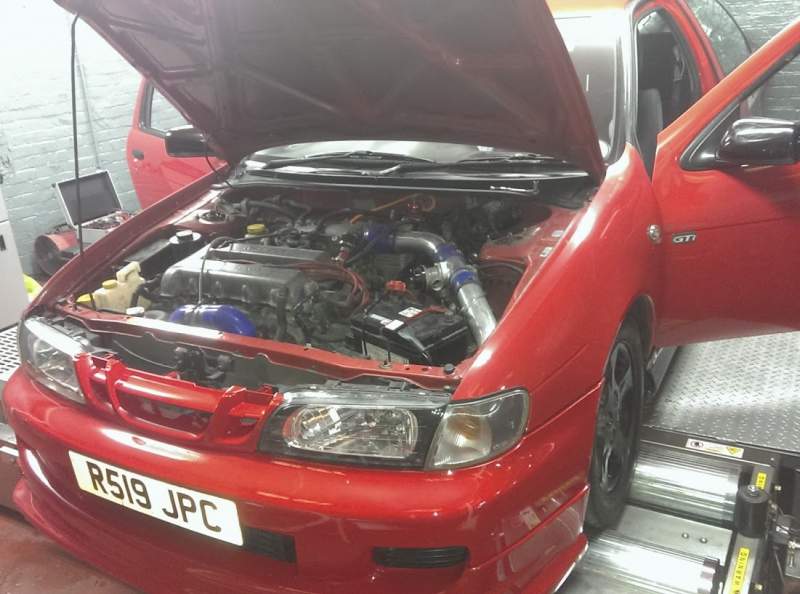
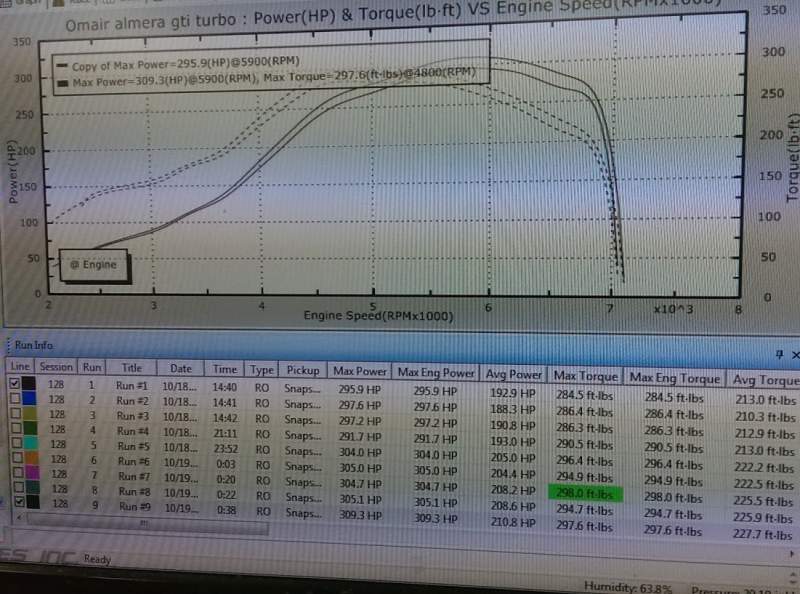
With regards to completely bone-stock NA Nissan engines with a turbo strapped to them, here is one I mapped last night completely from scratch on a £40 SR20DE engine: Not bad at stock actuator pressure of 0.55bar on a T28H. Completely maxed out the Almera MAF at 309bhp & 297lb·ft. Fun car, quite a handful for me on the dyno. I'm looking forward to some VG30DE-T builds in the future, who's game? Howard, your car was immense. You will love it when you get your hands on it. Might need better brakes... Willy-waving hijack over. Sorry :wack:
-
Not necessarily, but would need mapping to suit.
-
Link might help..... http://www.300zx.co.uk/forums/showthread.php?165254
-
Not applicable in this case. By that I mean incorrect finish on the mating faces, incorrect torque or excessive boost levels. Cometic gaskets offer little, if any, sealing advantages over the stock items.
-
This is a good thread from 2 years ago where there is a solid debate between RobH & myself about spark plugs. He approaches it from the "Manufacturer is always right" point of view, as he's a spark plug dealer. Me, from a tuner's point of view. Both valid approaches. I've not gone through the posts I made back then, so some may be due for updating based on 24 months of subsequent experience :laugh: