

Everything posted by Noz
-
Modified JDM maps are risky in this country unless you're running 99RON & octane booster. Assuming the figures are correct, it's likely the ringlands on cyl 6. Hence the numerous owners in just a few months. Hope you get it sorted.
-
Run the biggest gap possible without the spark being blown out, it can vary from car to car. BKR7E are a suitable plug for the VG at 14 psi / ~1 bar on stock turbos. BCR8ES have been fine in mine running up to 1.7 bar of boost, as well as in my old Pulsar at 1.9 bar of boost and my MR2 Turbo at 2.3 bar of boost. They aren't really required unless you're running big power/boost, but they've been fine in my Zed at various power levels.
-
Switchable launch control is operational. Rev limit set to 3200rpm just for demo purposes. Fully customisable using the stock OEM Nissan rev limit system so nice & safe. https://www.facebook.com/photo.php?v=10151892358236621&l=8772299458827325282 https://www.facebook.com/photo.php?v=10151892358236621&l=8772299458827325282
-
Good to hear :D I've not bought the new Profec yet, my manual boost controllers keep me sweet for the time being :)
-
How's the car running?
-
Haha :D Hi! Sorry, thought I had responded ages ago. You have PM :)
-
Turbonoz Forum section, PM, this very thread, email, Facebook, my website, 2 telephone numbers (call or text), Amazon :wack:12.5:1-13:1 on cold start? That's OK assuming it gradually leans out. 12.5:1-13:1 on warm idle is not so good unless you're running high-lift cams and don't like the lumpy idle. Stick with coppers and just change them every 5k miles or 1 year.Standard ECU chip:
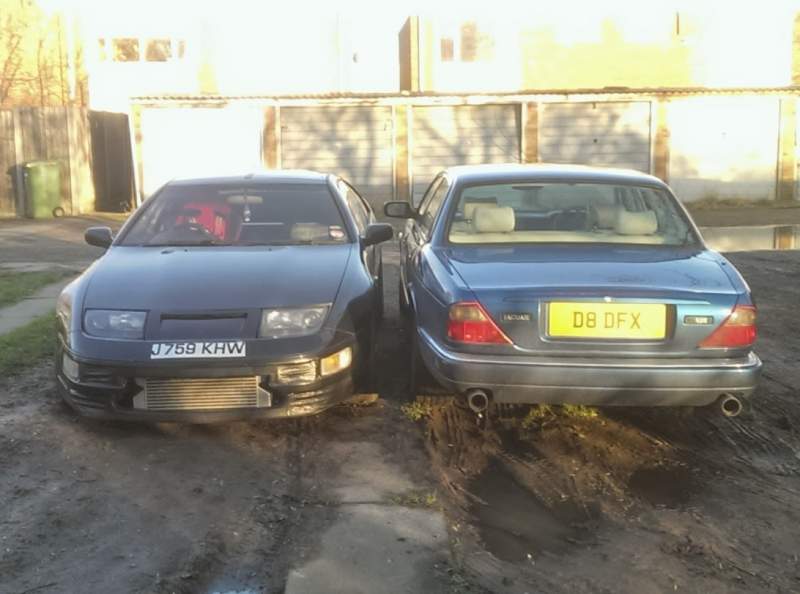
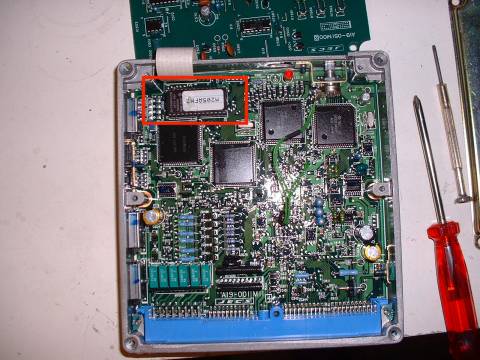 Need to have a look inside the ECU, or download the map.Come on now people, it's the part number that is important, not the price :hammer: The VG runs perfectly well on £2.50 NGK copper plugs (assuming they're the correct type of course, typically BKR*E). The OEM ones are platinum so the plug service interval is 60k as opposed to 10k. They are specifically designed for the VG30DETT cylinder head, the BKR*E range of both copper & iridium are only a tiny bit shorter. It's not the quality, it's the one-off design & longevity you paid for. Conversely, the 'cheaper' plugs actually work out more expensive in the long term. Best to keep it at stock boost on the platinums. You shouldn't gap them, so you're stuck with the stock 1.1mm gap, and they're a heat range 6. They are indeed the OEM plug for a brand new stock Zed and will work perfectly. The others would have worked too... The plugs in my Zed cost about a tenner all in and are quite different to the OEM design (~2mm less projected). They create a spark when I tell them to and allow me to run at 1.7 bar without risk of preignition. They don't foul, there are no misfires, it always starts perfectly and I get 17-28mpg with a slushbox. No one would ever know the shocking truth! Sure, I could pay £150+ for 6x NGK R7436-8 race plugs to do exactly the same job for possibly 5 times as long, but I don't know why I would ever want to :wack: Platinum does not mean better quality. A spark is a spark. It simply makes that spark for longer in a stock vehicle. If you have to choose a long-life plug, it may as well be iridium at any rate.Completely depends on the specification of the car and what the ECU has been mapped for.If you're fouling plugs, try some fresh copper NGK BKR7E plugs for the time being. They do exactly the same job as Iridium (thin-wire centre electrode) plugs and are less prone to failure due to fouling. They are longer than the BCR8ES that I use in mine, so closer to stock design (not that I've found any issues whatsoever running BCR8ES). Don't use platinums. Injectors much bigger than 740cc will idle just fine as long as the mapping is correct. You need to be measuring AFRs to see what's happening.I test drove an immaculate BPU Supra and was bored senseless, so I bought a 520bhp Skyline shed. My current favourite car is my little Clio RS172 Ph1. I like it so much that I'm selling the XJR. Which I really really like. I'm just amazed at how good some French cars are when they get them right. Goes like the clappers too. Relatively speaking. The Zed is just a great car. It handles really well, goes incredibly well once all the factory-spec restrictions are dealt with, and are amazing to look at with good road presence. I just wish there had been a more focused bare-bones version sans air-con, ABS, HICAS etc from the outset. Well, maybe not minus the ABS...James (Jaffa) had/has one fitted too at 700ish brake. To be fair, I've sold over a thousand of the things over the years. The highest boost pressure I've used them with is 1.9 bar on my Pulsar :wack:The new Profec is the best EBC I have worked with. Incredibly accurate. Next would be the Profec B Spec II as it's just so simple. On my own cars, I just fit one of my own MBCs :DMine's possibly the fastest Auto out there, although I'm going manual soon. I had a drag race at TOTB against paulzx (#6) and pulled my best time ever (12.62s) shortly before the gearbox lost a few gears. Street legal, it is Jaffa's. Fastest car I've ever driven by some margin. There's a black Zed that's getting high 11s at the moment too (belonging to a guy named Mike I believe).Hello Tom, thanks for the kind comments. The 12.62s was with a failing autobox as well, so plenty more to come. Glad you're enjoying the power, your car responded very well and was a joy to drive. Today, I have started work on SWITCHABLE LAUNCH CONTROL using an internally-modified standard ECU. With the set up, it should work as mild antilag and be able to produce decent amounts of boost whilst stationary. Oh, and big flames & bangs too :clap:Brought it out of hiding and had some fun over the weekend. Makes the Jag feel like a bus, I'd forgotten just how ridiculous it is with close to 500lb·ft and zero lag.
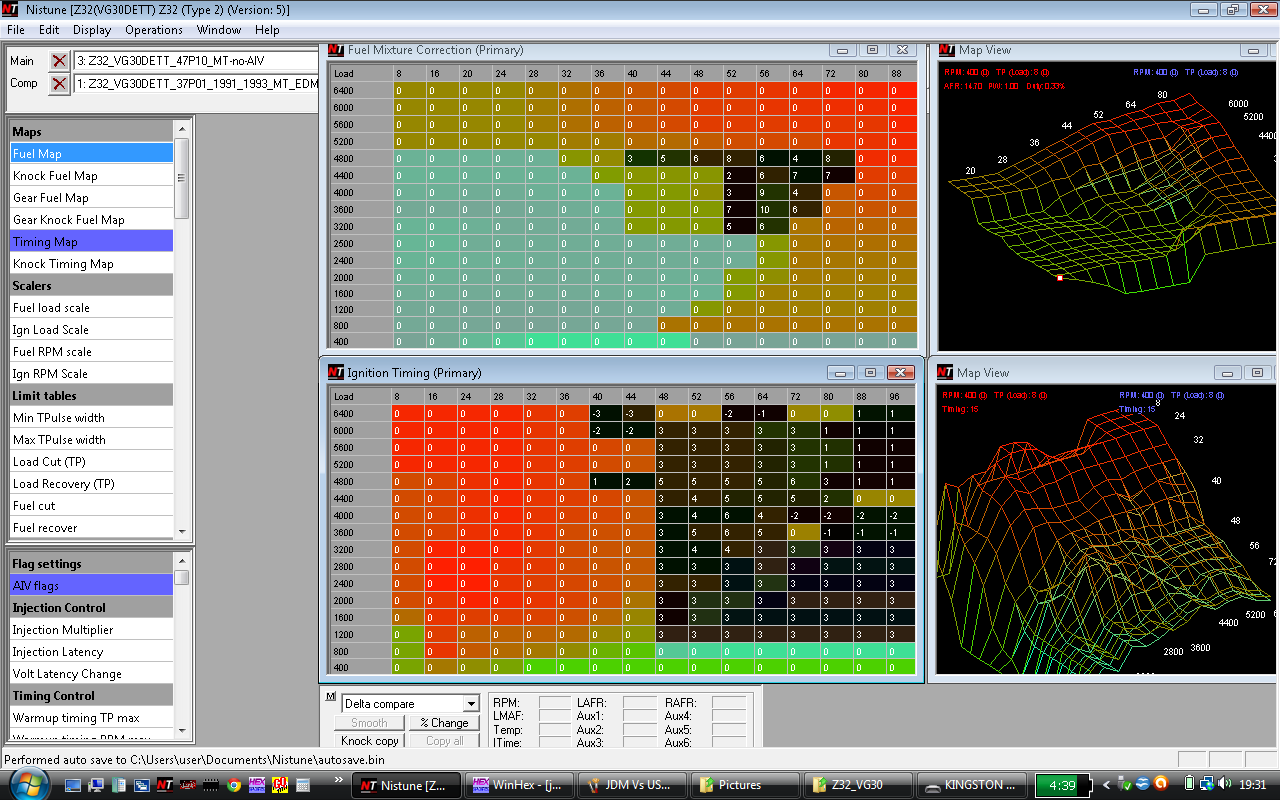
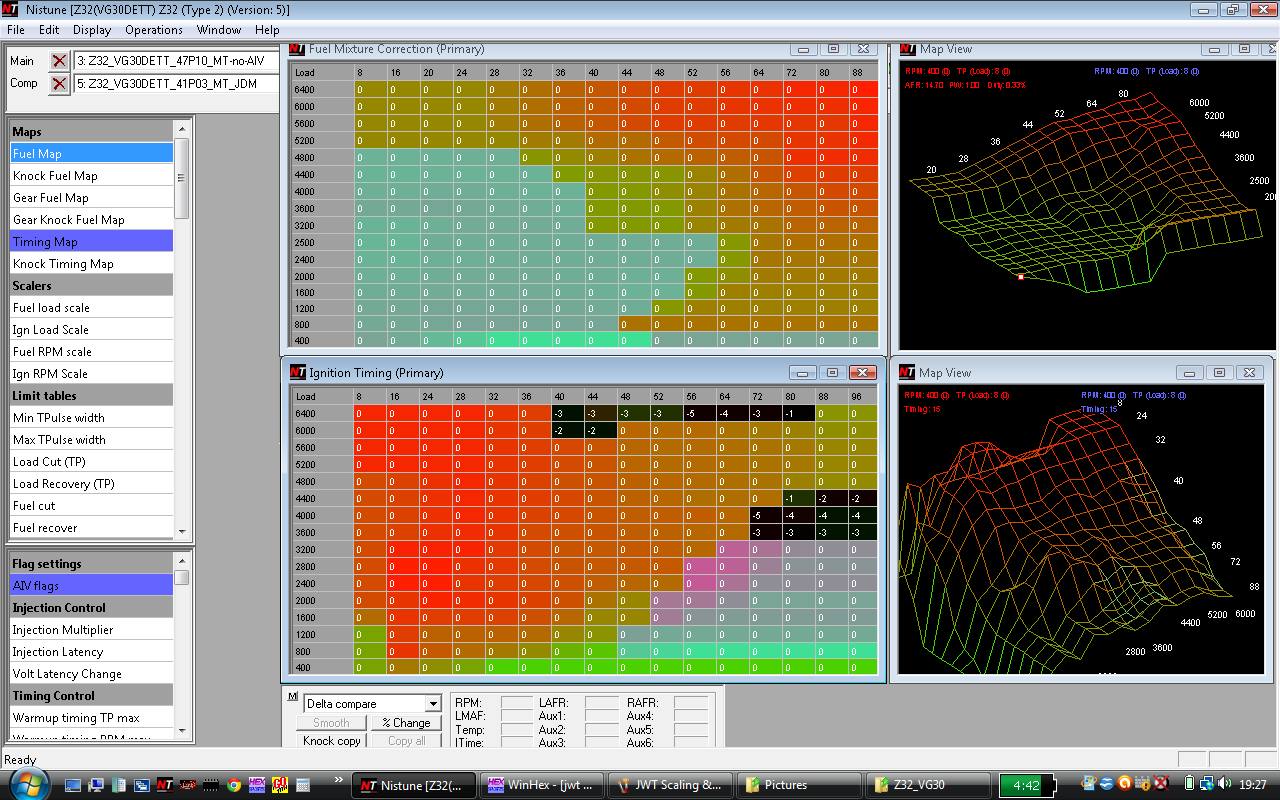
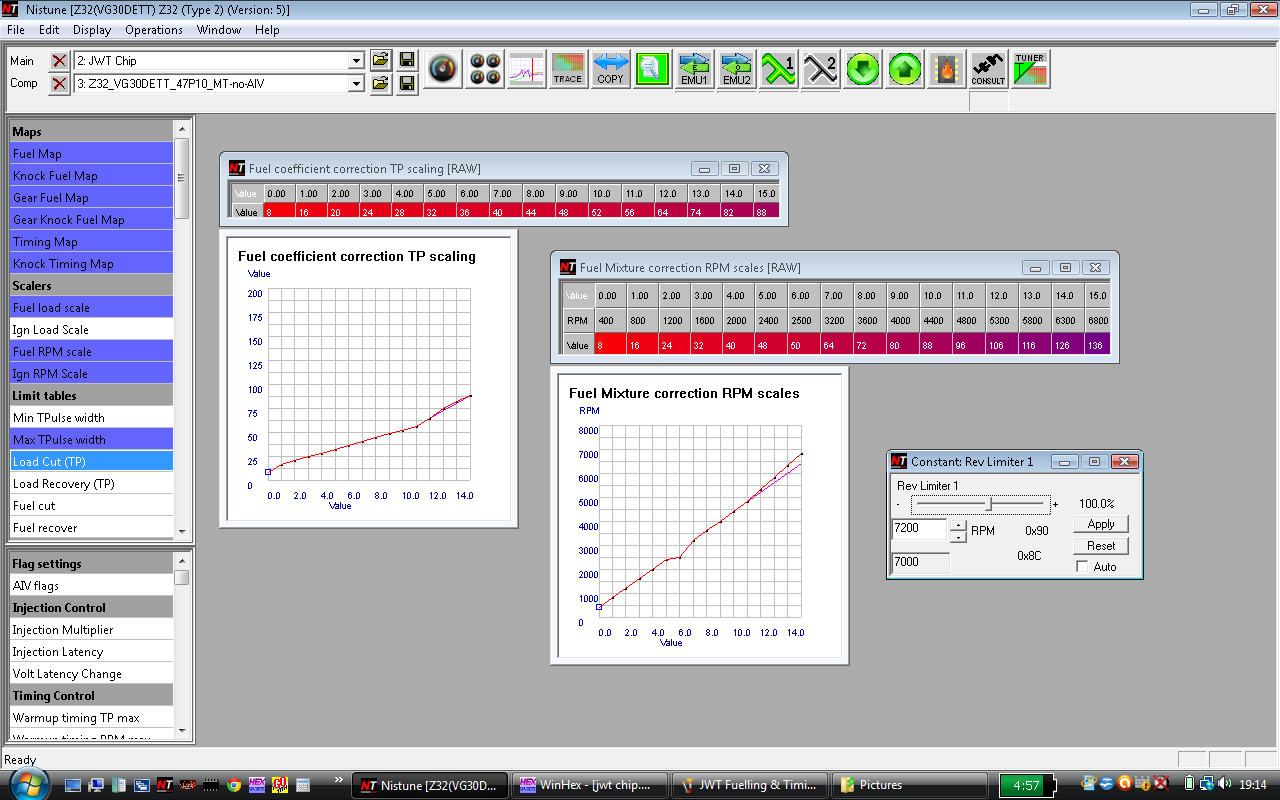
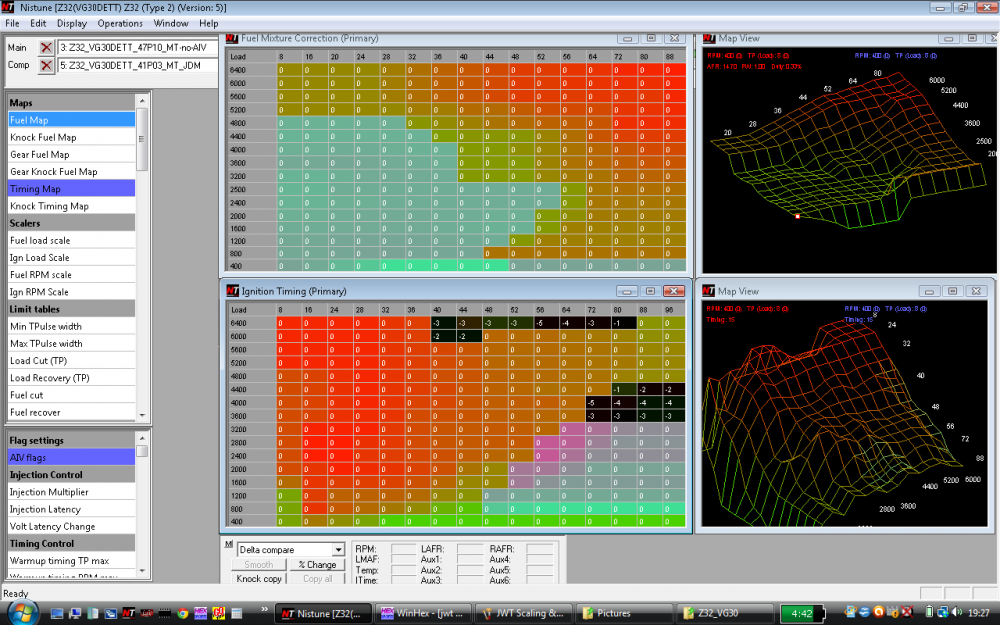
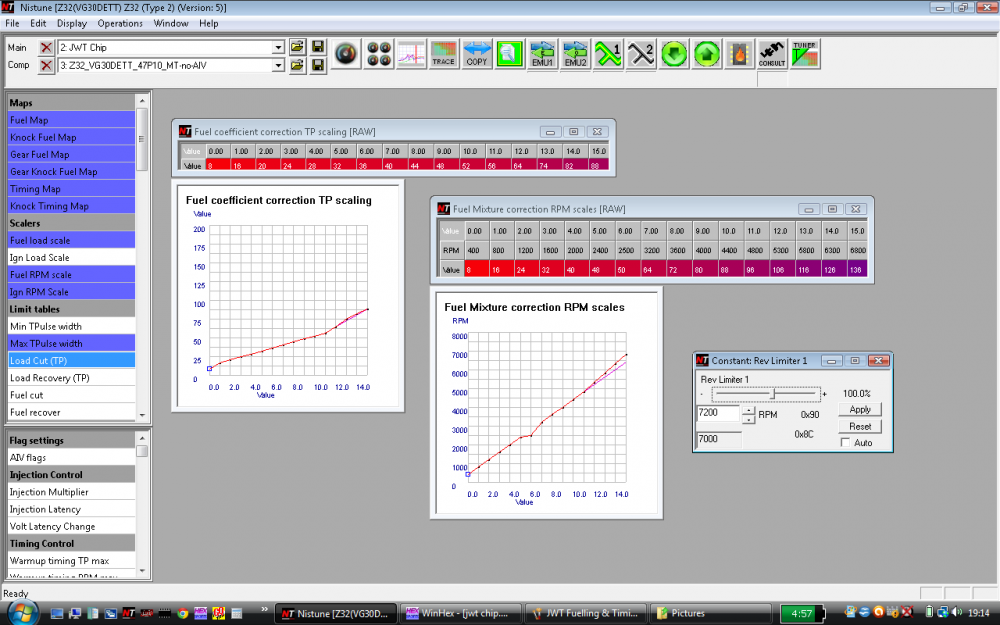
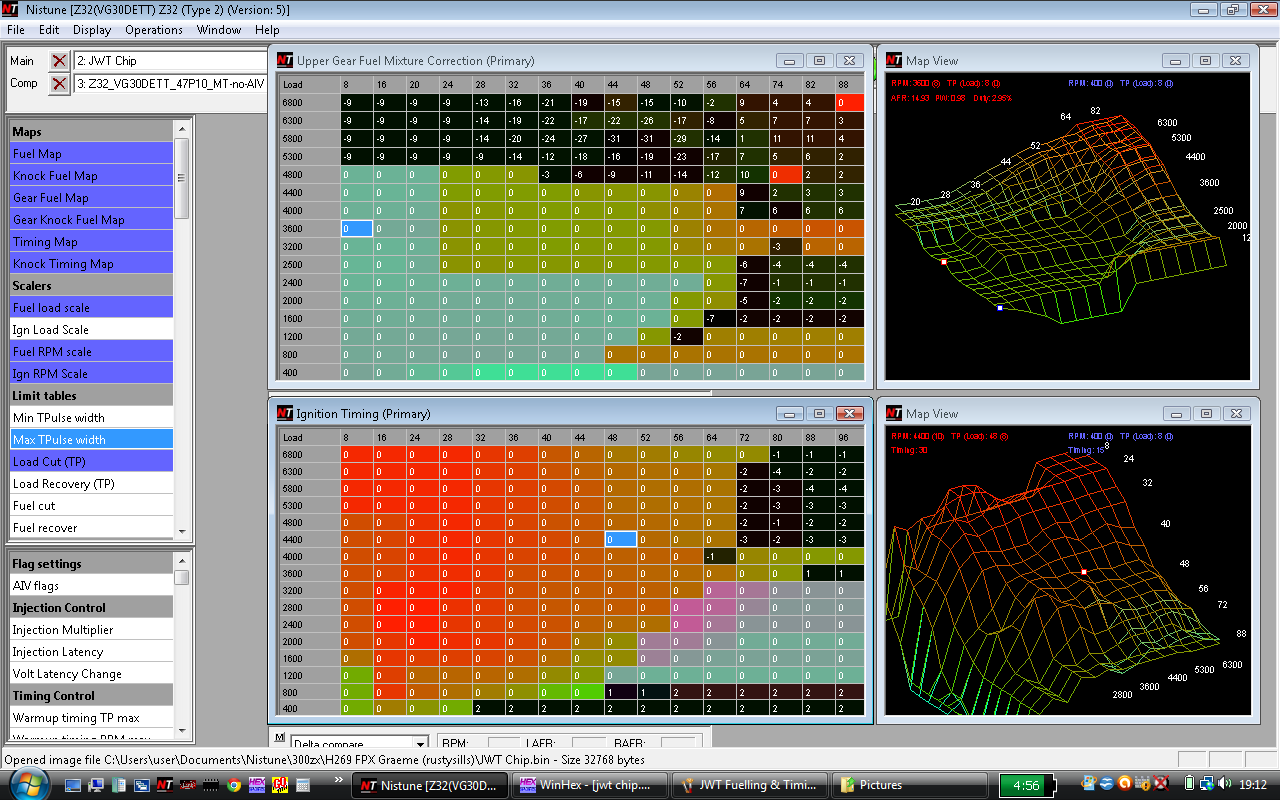
 Is this resolved? It won't be your O2 sensors. The fuelling goes into open-loop upon hard acceleration, so O2 sensors have zero effect on AFR. It was mapped to the usual AFR I map most Zeds to using a calibrated wideband lambda sensor, so it wasn't overfuelling when mapped. Still have all the log files from your session :) Have you investigated possible boost leaks?The stock maps run very rich. They're not as bad as Toyotas, but typically you see mid 10s AFR at high load. This gives plenty of room to increase the boost past the maximum load level of 88 without it running lean. At Load = 88, the estimated injector pulsewidth on the stock 47P10 fuel map is between 14ms at 3600rpm and 16ms at 6400rpm. This typically corresponds with an AFR of 10.6-10.8:1 (rich). Now, when boost is increased past this maximum level, the pulsewidths remain the same (14-16ms). More air is going in, but the fuel remains the same, hence it results in a more lean condition. This is fine up to a point, typically 12:1 AFR. The problem is that the timing also follows the same protocol, but luckily was programmed up to a maximum load of 96 (often Nissan did this). So, the timing is pegged at 20-22° BTDC, when it should be retarded due to the increase in load & intake temperature. Naturally, correct modifications can help here such as FMICs. The Toyota MR2 Turbo runs so rich (low 10s on boost) as standard, I was able to run 1.4 bar on the stock turbo & ECU after retarding the base timing and it sat at a nice 11.5 AFR.JWT Chip vs OEM 47P10 (USDM). The JWT chip is based on the 47P10 USDM map, not the EDM (European Domestic Market) specifically tuned by Nissan for European (inc UK) fuels.... See Pics 3. & 4. below. The following loooooong post is how I typically do a very basic map analysis. Fuelling & Timing Differences: As can be seen, the percentage of the fuelling & timing maps that differ from one another isn't great. The top map is the fuelling, and for some reason the majority of the work has gone into the high RPM light load areas, typically where an engine rarely operates either day-to-day or on track Load points 8-56). Fuel has been added top end (top-right corner). The bottom map is the timing, which is where you feel the difference during 99% of normal engine operation. In the case of the JWT chip, it remains unaltered for the most part from the stock US map, so off boost the car feels exactly the same as standard. The problem is, because the load points (scale along the top, can be thought of as 'boost') is the same as stock, in load columns 72, 80, 88 & 96, there is less timing, so at stock boost you will actually produce LESS power. Only when the boost is increased past the maximum load value of 96 does the reduced timing keep everything together. This would never be mapped like this in realtime as you are able to see what the maximum load value is, and the only benefits power-wise you are getting here is from the increased boost. OEM Load (boost) cut is increased, but the OEM is set at a value of 128 (higher than 88 & 96 mapped values for fuel & timing) so moot anyway. A decent boosting car hits 120 Scaling & RPM Limit: The above graph shows that the maximum load scale for both JWT and stock chip is exactly the same for the fuelling maps (value = 88). It is the same for the timing maps as well (value = 96). The RPM limit is increased from 7000 stock to 7200 RPM. The good thing about the JWT map is that the RPM scale is extended from 6400 to 6800 RPM, although still short of the 7200 RPM limit. This is one parameter that was porrly programmed in the OEM map (mapped to 6400 RPM with a 7000 RPM limit). Most likely to increase resolution and therefore drivability where the engine spends more time. USDM Vs JDM: As is plainly evident, there isn't a great deal of difference between the USDM & JDM OEM maps. Fuelling is exactly the same, timing is reduced slightly in a few places at maximum torque as this is where knock can be a problem. Note that these areas are above the knock-enabled feedback section. USDM Vs EDM / UK: Here we see the main issue: The difference between maps based on USDM / JDM spec cars and UK Zeds. Same goes for all grey imports, Nissan reduced timing and added fuelling at high load & transitional regions for the EDM 300ZX, Pulsar, S13, S14 et al to make them safe with 95 RON fuel. The cruise & low boost section are exactly the same, however. This is where a good generic chip will make the most of the 99 RON fuel by working with this section to improve off boost performance & fuel consumption, which is where 99% of cars spend 99% of their time. It can be argued that there are no doubt countless JWT-powered Zeds out there running fine, and I am definitely not disputing this. However, times have moved on with the advent of OEM-based live tuning options and standalone engine management and the job can be done properly. It wasn't long ago I was arguing with people regarding the perceived power abilities of the VG30DETT engine and stock components. I had all this data available then (I have done for about 5 years), but I wanted to let my own car & work do the talking rather than slate the 'opposition' so to speak :D The JWT chip is fine for its purpose (basic way to allow more boost using 98-99 RON fuel) but given that it's 90% just a stock chip, it simply doesn't do the Zed justice and the only extra power & torque is from the additional boost, nothing else. Drivability on the whole is unchanged, you simply lose a section of O2 feedback meaning it runs pointlessly rich above 2500 RPM when cruising. This is because it uses the High Gear fuel map 100% of the time, regardless of gear. I will say one thing, however... It is a lot better than the various 555 / 740 / 850 chips I've come across over the years. Please note I am not putting down anybody for using or selling the chips, and I really don't need to put down others to big myself up. There are also many other options for getting your car mapped, not just myself. I'm simply reporting the facts finally, when hopefully no one thinks I'm biased or trying to brainwash anyone. Look into my eyes, into my eyes, not around the eyes but into my eyes. You're under.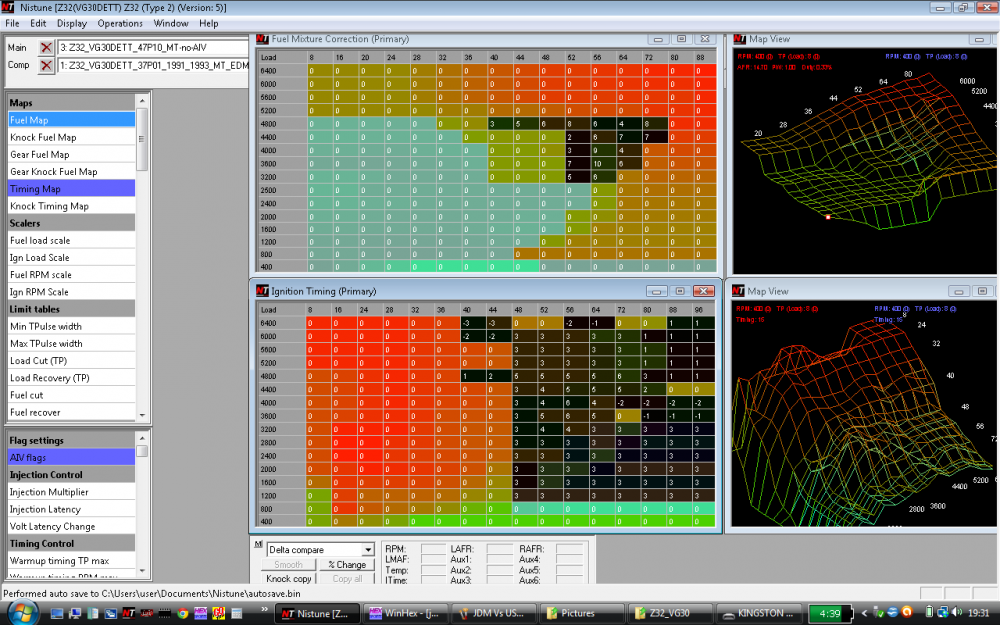
 The problem is, that they were never properly mapped in the first place, the bins were edited in a rudimentary fashion using hex editors once the files had been disassembled, hence the blanket addition/subtraction of fuelling & timing. It wasn't a case of road / traffic conditions, it was simply that the technology wasn't there. Regardless of traffic, there are optimum settings for a fuel & timing map for each specific car as you point out, but there are also close to optimum settings suitabvle for a generic chip. This can only be found by using current technology with real-time systems and a great deal of dyno time. Back in the day (circa. 2003) when I was at the mercy of having to use chips for my S13 that melted spark plugs, I decided to do it myself. When I started out I had to modify hex values directly, burn a chip, fit the chip, go for a run up the road, monitor fuelling & knock, stop, make necessary alterations, rinse & repeat. It wasn't possible to do it in real-time and a map would typically take a few days and even then, the results were poor compared to when I first fitted NIStune in 2008 and after just one day, hit 382bhp after the boys at MGT kindly let me have a play at an SXOC RR day (they couldn't believe the results for a 1809cc engine). I wouldn't have even got close doing it the old-fashioned way. Just too difficult. The JWT map isn't actually mapped for any extra boost over the stock maps, the fuelling & timing values are simply continued from the final column. It is based on the OEM 47P10 Manual Transmission (no AIV) file. Next post will be a full comparison of the JWT map and the OEM 47P10_MT file.That would be quite a hefty bill once it lands on these shores! Top of the range Link G4 is around £1200 tops. But, as already mentioned, for 450-500 horses and non-motorsport applications, the OEM system more than adequate. It is fully mappable within certain constraints, with launch control even being possible on some models (similar to the Mitsubishi Evo ECUs).