Generations: Datsun/Nissan Z Cars
By John Pearley Huffman
As spectacular a sports car as Datsun's original 1970 240Z was, that it was a sports car hardly mattered at all. What did matter was that it was a Japanese vehicle that competed with the best of Europe and America in quality, performance and sheer sexiness and beat them — without sacrificing the keen pricing advantage that opened the door to Japanese imports in the first place. The 240Z was the Japanese car that was so desirable in so many ways that buyers would have happily paid more for it. It was a breakthrough for the entire Japanese automobile industry and suddenly buying Japanese didn't necessarily mean you'd made a compromise or settled for second best.
Over the next 26 years, Datsun became Nissan and the Z grew into the 260Z, 260Z 2+2, 280Z, 280Z 2+2, 280ZX, 280ZX 2+2, 280ZX Turbo, 300ZX, 300ZX 2+2, 300ZX Turbo and ultimately the 300ZX Twin Turbo. Then the Z car went away (from America at least). But it came back seven years later as the 350Z, reborn with an infusion of the original's character even as its engine swelled to the greatest displacement yet.
Some of those successor Zs were just as purely sporting as the original 240Z, while others were barely more than disco-era Japanese versions of the Buick Regal. But they were always interesting…sometimes like a hurricane through a trailer park interesting, but interesting nonetheless.
First Generation (1970-1978): The Original Z
There was nothing startling or especially original about the 1970 Datsun 240Z two-seat coupe. The MacPherson strut front suspension was taken straight out of Datsun's 1800 sedan and the rear suspension was a "Chapman strut" design, which was basically a MacPherson strut system for the hind end. The engine was the 510 sedan's 1.6-liter, OHC four with two more cylinders grafted on to make a surprisingly lusty 2.4-liter SOHC straight six (the bore and stroke dimensions were unchanged from the 510) with dual SU-like carbs. It was backed by a familiar four-speed manual transmission. There were disc brakes in the front, but the rear still used ho-hum drums and the structure itself was an ordinary unibody with a 90.7-inch wheelbase. Even the styling was derivative with Ferrari GTO-like proportions and a Jaguar E-Type-inspired nose capped by a delicate bumper and framed by headlights recessed into ice scoop buckets mounted in the front fenders. The interior was clean with its high-back bucket seats and instrumentation deeply tunneled into the dash, but again no great shakes innovationwise.
Though it lacked originality, the 240Z was immensely attractive and, with 150 horsepower pushing just 2,320 pounds, decently quick for the era. Sports Car Graphic stirred the four forward gears of the first 240Z to go from zero to 60 mph in just 8.2 seconds and complete the quarter-mile in 15.5 seconds at 86.5 mph. And it only cost $3,500 — a screaming bargain. "We think Datsun has a real winner," wrote Road & Track at the time, daring to state the incredibly obvious.
With sweet handling and an undeniable star presence, Datsun had no problem selling 16,215 Zs that first year. So for 1971, the company didn't mess with it, and sales more than doubled to 33,684 units. Again essentially unchanged for 1972, the 240Z saw its sales rise to 45,588. Changing practically nothing for 1973 resulted in another 46,282 Zs hitting this country's fair shores. But with new bumper regulations (and more weight) coming and emissions regulations threatening to strangle output, there would have to be some changes.
Changes arrived in the form of the 1974 260Z. The name was earned as the straight six was stroked to displace 2.6 liters while it still inhaled through two SU-style carburetors. "It's an updated version of the 240 that includes the required safety equipment," wrote Motor Trend, "yet continues the virtues of its forebear." But the extra displacement couldn't keep engine output from dropping to 139 horsepower with the new emissions equipment and the federally mandated 5-mph bumpers' weight helped push weight up to 2,580 pounds. So zero to 60 now took 9.9 seconds according to Motor Trend.
The 260Z coupe was now but one model in the Z family as a new 260Z 2+2 joined it in Datsun dealer showrooms. With a wheelbase 11.9 inches longer than the two-seater's, there was now room for a tiny rear seat under an awkwardly shaped roof. With a three-speed automatic transmission available as an option, the heavy and relatively slow 260Z 2+2 was hardly a sports car — and a harbinger of the direction the Z car's evolution would take.
The 260Z lasted just over one year, as the 280Z appeared late in 1975 with a new 2.8-liter version of the SOHC six now running with Bosch fuel injection. The extra displacement and fuel injection system bounced engine output up to 149 horsepower, but the two-seater now weighed 2,875 pounds
and Road & Track could only manage a 9.4-second 0-to-60-mph time. Buyers still scooped up the Z, however, with almost 52,000 coupes and 2+2s getting to American buyers during '75. So Datsun didn't change anything for 1976 and sold nearly 60,000 of them over here.
A five-speed manual transmission finally replaced the four-speeder as standard equipment on the 1977 280Z, but the other changes were mostly cosmetic with phony hood vents replacing the access ports atop each fender. Those vents must have been enchanting since sales ripped past a combined 70,000 coupes and 2+2s for '77. Then, Datsun made an AM/FM radio standard for 1978 (with the price now at $7,968 for a coupe, a good radio should have been standard) and that was that for the original Z.
After nine years, the original Z had become an icon of '70s cool and sophistication. But would Datsun resist the disco era's influence and maintain the car's sporting roots? Or succumb to temptation and embrace the KC and the Sunshine Band generation?
Third Generation (1984-1989): The Wedge 300ZX and 300ZX Turbo
With the Nissan name now firmly in place, a new Z car took up residence in the former Datsun showrooms that clearly broke with the old Z styling and engineering themes. A new 3.0-liter SOHC V6 now filled the engine bay — an engine that made 160 horsepower normally aspirated and a full 200 when turbocharged. A five-speed manual transmission was standard with either motor, and a new four-speed automatic was optional with both.
The 1984 ZX's profile had a pronounced wedge shape with distinctive pop-up headlights that seemed to peep out from slots in the chiseled nose when they were down. The 300ZX had an almost antiseptically clean, even boring, design, though turbo models (all of which were two-seaters) had a distinctive scoop along the left side of their hoods. Optional "body sonic" seats (that vibrated to the music) marked the zenith of electronic excess.
While the engine was new, the chassis was similar to the 280ZX's with a too-soft trailing arm rear suspension, mushy MacPherson struts up front and the same 91.3 inches of wheelbase between them. This was a new car, but it was carrying forward the personal luxury example set by its immediate predecessor rather than reigniting the passion of the original Z. But it was popular with more than 70,000 ZXs being sold in America during '84.
T-top lovers burst out in joyous song with the announcement that these removable roof panels were standard on all 1985 300ZX models. Beyond that, however, the '85 carried over from '84 with changes.
The Turbo model lost its hood scoop and gained 16-inch wheels for 1986. Additionally, all models now had rocker panel flares, and there was a new base model that did without T-tops. In a comparison test against the '86 Toyota Supra, Mazda RX-7 Turbo and Dodge Conquest TSi, Motor Trend wrote, "In a four-car contest somebody has to finish 4th. The 300ZX Turbo has a mouthwatering engine, producing 200 smooth, effortless horsepower, but it is handicapped by its mediocre-at-best chassis…. The 300ZX suspension doesn't control pitch motion adequately, body roll is only slightly better and it's the combination of these motions that limits the car's handling performance. Even in steady-state cornering conditions like the skid pad, the 300ZX is almost 10-percent slower, at 0.80 g, than the others." Still, the '86 300ZX with its single turbo was decently quick, making the trip from zero to 60 mph in just 7.5 seconds with the quarter-mile going by in 15.9 ticks for Motor Trend.
A soft-edged restyle in 1987 rounded the 300ZX's lines a bit, and a new turbo and other revisions added five horsepower to both the naturally aspirated and Turbo models for 1988. But as the 300ZX carried over virtually unchanged into 1989, it was obvious that it was a car whose time had come and gone — a 1970s idea executed with 1980s technology. And now it was the 1990s….
__________________
"Thats not a racing car, thats just pornography" Jeremy Clarkson
--------------------------------------------------------------------------------
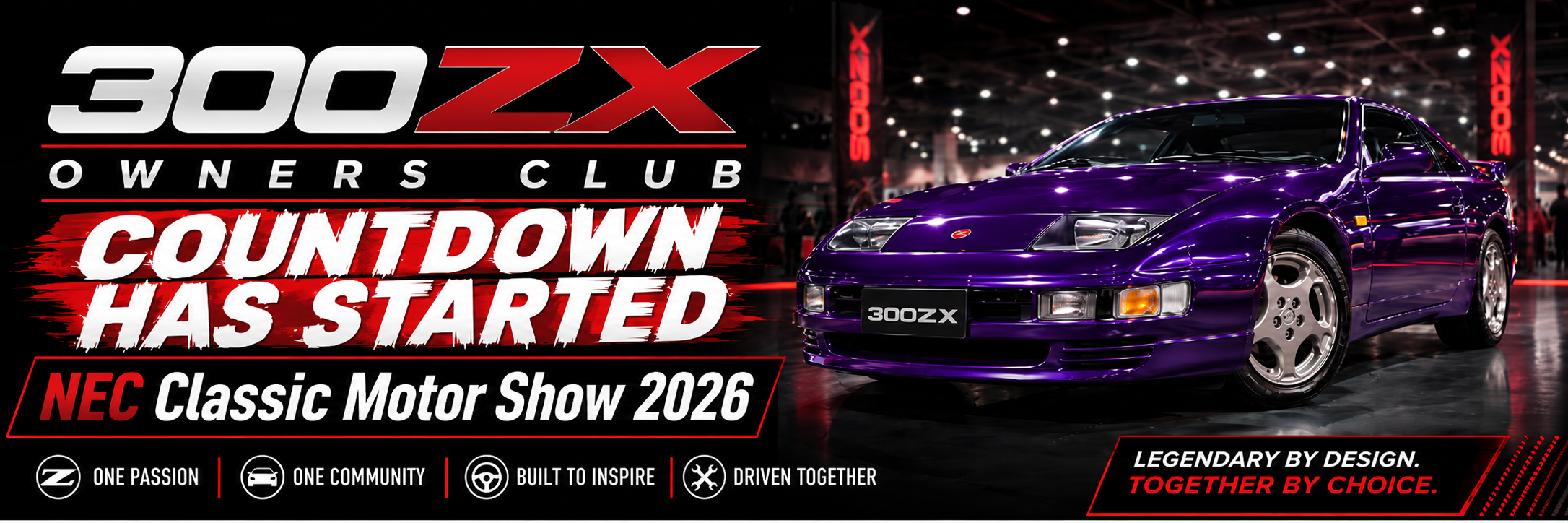
Fourth Generation (1990-1996): The Almost Exotic 300ZX and 300ZX Twin Turbo
Few cried as the third-generation Z car mercifully left production. But no one was quite prepared for the all-new, all-awesome 1990 300ZX and 300ZX Twin Turbo that succeeded it. Motor Trend awarded the 300ZX Twin Turbo its 1990 Import Car of the Year award, saying: "The 300ZX Turbo has abundant personality, alternately as docile as a well-mannered child and as aggressive as Schwarzenegger in The Terminator, dependent only on throttle position…. It offers the world-class performance of the Porsche 928 S4 and Chevrolet Corvette, but duplicates neither. It doesn't challenge drivers' ability with a hair-trigger, superstar temperament." In winning that title, Nissan's newest Z beat, among others, the then-new Lexus LS 400, Mazda Miata and Infiniti Q45.
The '90 300ZX was stunning; it was wide, squat and from every angle fascinating. The previous 300ZX looked soft and was soft, but this one looked tough and eager to dominate even in the longer 2+2 variant. The wheelbase now stretched to 97.0 inches on the two-seater and separated a supple and advanced suspension using multiple links and A-arms up front, and a multilink system in the rear that incorporated Nissan's "HICAS" (High Capacity Active Suspension) system. HICAS included some rear steering that depended on vehicle speed, steering angle and other parameters. This was easily the best-handling Z car yet and one of the world's great road cars at any price.
And it was fast. Normally aspirated 300ZX two-seaters and 2+2s were powered by a new 24-valve, DOHC, 3.0-liter V6 making 222 horsepower — that's 17 horsepower more than the '89 300ZX Turbo. The Twin Turbo used a pair of turbos blowing through twin intercoolers in a densely packed engine bay to make an astonishing 300 horsepower. Motor Trend had the Twin Turbo rocketing to 60 mph in just 6.0 seconds and whipping the quarter-mile in 14.4 seconds at 102.5 mph. It was, by far, the quickest Z car ever offered by the factory. Beyond that, it was the fastest car Motor Trend had ever piloted through its slalom course at that time.
If this generation 300ZX had an Achilles' heel, it was weight. The '90 Twin Turbo weighed an astonishing 3,474 pounds, which was a couple hundred pounds more than a Corvette, a couple hundred pounds more than the '89 300ZX Turbo and nearly 1,200 pounds more than the first 240Z. But this 300ZX was more comfortable than any 'Vette, much more aggressive than the '89 model and just as uncompromised a sports car as the 240Z. It was a remarkable achievement even if, at $33,000 for the Twin Turbo, it sure wasn't cheap.
No big changes were made to the 300ZX for 1991, though a new stripped-down model (no T-tops) was offered. A convertible version, powered by the naturally aspirated engine, joined the 300ZX lineup midway through the 1992 model year and featured an integrated roll bar. But apart from the introduction of the convertible, what was most remarkable about this generation of ZX was how little it changed. What few changes occurred for 1993 are barely worth mentioning, the big news for 1994 was the addition of front airbags and a keyless entry system, and both 1995 and 1996 were straight carryovers.
As wonderful as this car was, it was too expensive to sell in huge numbers (with the Twin Turbo costing nearly $45,000 by 1996) and almost ludicrously complex in Twin Turbo form. In a world increasingly obsessed with SUVs, the 300ZX seemed almost an anachronism. It was a shame that it was withdrawn from the American market after the '96 model year, but it was understandable, too.
Fifth Generation (2003-Present): The 350Z
After a six-year hiatus, the Z car returned with a vengeance in mid-2002 as a 2003 model . Harkening back to the original, the new Z was available only as a two-seater and only with a naturally aspirated six-cylinder engine. But it was also a thoroughly modern car with its big wheels now pushed out to the corners, knife-edge headlamps, an aggressively hunkered down cockpit and a tapered tail.
Powering the new 350Z is the "VQ35DE" 3.5-liter, DOHC, 24-valve V6 which, thanks to such 21st century technology as continuously variable valve timing, along with time-tested hot-rodding tricks such as a relatively high (10.3-to-1) compression ratio, makes a thick 287 horsepower at 6,200 rpm and a healthy 274 pound-feet of torque at 4,800 rpm. There's nothing exotic about this engine (other versions of the VQ35-series V6 power Nissan's Altima and Maxima sedans, the Murano SUV and the Quest minivan and Infiniti's G35 sedan and coupe), but behind its six-speed manual or five-speed automatic transmission is a super-trick carbon-fiber-reinforced plastic driveshaft leading (except in the base model) to a limited-slip rear differential. Instrumental testing by Edmunds editors yielded a 5.6-second 0-to-60-mph run and a 14.2-second quarter-mile at 99.7 mph from the six-speed model.
The 350Z's structure is, like every previous Z car's, a unibody design and the suspension is similar in concept to the last 300ZX in that it uses multilink systems at both the front and the back. However, the new car uses more aluminum components in the suspension and features strut tower braces spanning both the engine bay and the rear cargo area. Those strut tower bars make the suspension more secure and stiffen the entire structure, though the rear one also limits cargo capacity.
With the engine's centerline located behind the front axle line for better weight distribution across a relatively long 104.3-inch wheelbase, the 350Z's balance is among the very best of any car's at any price. And best of all, the 2003 350Z's price wasn't "any price" but a downright cheap $26,269 for the base model. Reviving the 240Z's value heritage was certainly a good idea.
Edmunds was immediately enthusiastic about the 350Z even if we found the car's five trim levels — from base to hard-edged and big-braked "Track" model — a bit dizzying. "The six-speed's shifter has short throws and precise gates," wrote Brent Romans, "and the automatic can pop off impressively fast upshifts…. It's an easy car to get acclimated to and drive fast." For braking, the 350Z has ABS- and EBD-equipped vented discs at each corner. Track models have brakes designed by aftermarket brake specialist Brembo. These rotors are larger and thicker and are clamped down upon by larger calipers. On certain trim levels (including the Track), Nissan's Vehicle Dynamic Control (VDC) stability control system is available."
With the Infiniti G35 coupe, which shares its "FM" (front midship) platform with the new Z car, effectively acting as a 2+2 version of the 350Z, there's no reason for Nissan to soften the two-seater too radically to attract buyers. But in 2004 the company did show there was room for variation on the Z theme with the introduction of the 350Z Roadster.
Could a Twin Turbo version of the 350Z appear? Sure, anything's possible. But as it stands right now, the 350Z is already the best Z car ever. We'll start whining when and if they decide to add an X to the name.
source:http://www.edmunds.com/insideline/do...cleId=100641#2
__________________
"Thats not a racing car, thats just pornography" Jeremy Clarkson
There you go.