
Jump to content
View in the app

A better way to browse. Learn more.

300ZX Owners Club

A full-screen app on your home screen with push notifications, badges and more.

To install this app on iOS and iPadOS
  1. Tap the Share icon in Safari
  2. Scroll the menu and tap Add to Home Screen.
  3. Tap Add in the top-right corner.
To install this app on Android
  1. Tap the 3-dot menu (⋮) in the top-right corner of the browser.
  2. Tap Add to Home screen or Install app.
  3. Confirm by tapping Install.

Engine sensor recordings- help interpret

This is what I recorded yesterday using ECUtalk. I edited the video down to 4:15, just from the time I got on the interstate and exited again.


Apologies for all the clicking picked up by the microphone, the only thing I can think is it was rubbing on the leather seat?


I think everything looks normal. Car did not go into safety boost, which is what I was hoping I would get so I could record what the engine was doing when it occurs. My theory of a faulty MAF seems to be disproved by this recording, at 6,000 rpm with 3.26 volts on the throttle (and about 10.5 psi boost) the MAF was at 4.16 v (this is at approx. 110 mph, in 3rd gear- automatic transmission). However, the MAF was showing a bad reading with the ignition ON (engine not running) of 0.44 with a voltmeter, ECUTalk recorded 0.08 volts. Service manual says it should be 0.8 volts.


ECUTalk could not read the speed, I believe the consult adapter I got on Ebay is faulty. It also causes a code 14 Speed sensor fault, and sets off the HICAS warning light, and to make things just peachy it puts the power steering into "high speed mode"- fine for the freeway, not so great on city streets. Removing the consult adapter from the vehicle's plug restores everything to normal. So I am asking the seller for a replacement adapter, assuming this one has some kind of internal short.


Also did a power balance test when I got home using OBD Scantech. Got an rpm drop on every cylinder, so presuming I have no misfires (at idle anyway). Is it worth re-running the balance test at higher rpm (I saw that as an option)?


Power Balance Test Summary On 9/13/2014 5:08:33 PM

Coolant Temperature: 189 Deg {F}

Idle Air: 24 %


Cylinder # 1

Cylinder On Stablized For 2 Seconds

Average RPM When Cylinder Stablized... 845 Rpm

Cylinder Off Sampled For 3 Seconds

Average RPM When Cylinder Is Off... 802 Rpm

Average RPM Drop Result... 43 Rpm

Highest RPM Drop... 95 Rpm

Amount Of Data Sampled When Cylinder Off... 182


Cylinder # 2

Cylinder On Stablized For 2 Seconds

Average RPM When Cylinder Stablized... 869 Rpm

Cylinder Off Sampled For 3 Seconds

Average RPM When Cylinder Is Off... 827 Rpm

Average RPM Drop Result... 42 Rpm

Highest RPM Drop... 69 Rpm

Amount Of Data Sampled When Cylinder Off... 187


Cylinder # 3

Cylinder On Stablized For 2 Seconds

Average RPM When Cylinder Stablized... 877 Rpm

Cylinder Off Sampled For 3 Seconds

Average RPM When Cylinder Is Off... 817 Rpm

Average RPM Drop Result... 60 Rpm

Highest RPM Drop... 114 Rpm

Amount Of Data Sampled When Cylinder Off... 191


Cylinder # 4

Cylinder On Stablized For 2 Seconds

Average RPM When Cylinder Stablized... 873 Rpm

Cylinder Off Sampled For 3 Seconds

Average RPM When Cylinder Is Off... 815 Rpm

Average RPM Drop Result... 58 Rpm

Highest RPM Drop... 110 Rpm

Amount Of Data Sampled When Cylinder Off... 186


Cylinder # 5

Cylinder On Stablized For 2 Seconds

Average RPM When Cylinder Stablized... 864 Rpm

Cylinder Off Sampled For 3 Seconds

Average RPM When Cylinder Is Off... 817 Rpm

Average RPM Drop Result... 47 Rpm

Highest RPM Drop... 76 Rpm

Amount Of Data Sampled When Cylinder Off... 185


Cylinder # 6

Cylinder On Stablized For 2 Seconds

Average RPM When Cylinder Stablized... 869 Rpm

Cylinder Off Sampled For 3 Seconds

Average RPM When Cylinder Is Off... 817 Rpm

Average RPM Drop Result... 52 Rpm

Highest RPM Drop... 106 Rpm

Amount Of Data Sampled When Cylinder Off... 186


Can anyone tell me if this is all normal?


Thanks,


Mark

(Crossposted to every 300zx forum I am a member of)

  • Replies 80
  • Views 6.4k
  • Created
  • Last Reply

Top Posters In This Topic

Posted Images

Featured Replies

Right, so I understand that the 34 code reflects the state of the detonation sensor circuit as opposed to the instance of detonation.

1) How do you know that you're in safety boost (I ask for historical reasons as that happened to my first Zed and then replaced the knock sensor. That's the last time I go to JAE. Thanks Eric :D )

2) How does this apply to NAs? Obviously no safety boost but does it do anything else?


1)

From a mapping point of view: Nistune tells me, it flags which tables are being accessed by the ECU in realtime.

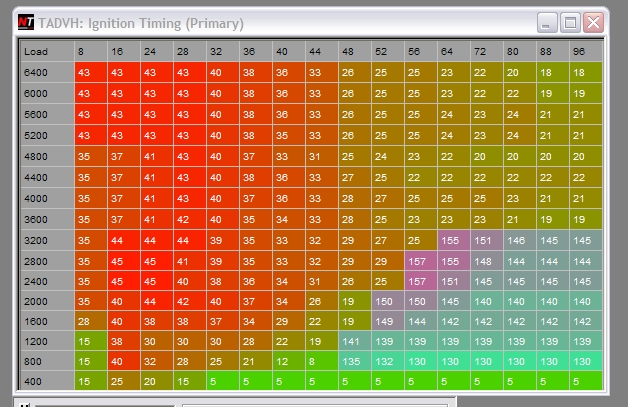
From a driver's point of view, boost drops down to the minimum pressure possible (actuator pressure, ~7psi). For EDM ECUs, fuelling in 17 load sites is increased (unchanged at full load & high RPM). Bear in mind that there are 256 load sites. Timing is pulled for a much larger region with the maximum difference being 11°. You would feel the lack of performance. ***


The JDM & USDM knock fuel maps are exactly the same as the regular maps, clearly they didn't see it worthwhile adding any fuel to halt det with the reduction in boost.


2)

NA Zeds have huge differences between regular & knock maps, and a much larger knock sensing area. You would feel it instantly, power & torque would probably drop by about 25%.


*** Looking at this EDM map, there are 16 instances (load sites) where the knock timing is actually higher than the regular timing. I've not noticed this before, it appears to be a genuine error by the Nissan engineers/programmers. They screwed up. Not the only time where the Z32 TT maps are concerned, either ;) There is a reason why you can overboost a Zed and no other Nissan from the same period without appropriate limiter modifications. Ever wonder why there is no mention of fuel cut issues...?

If an engine is running an aftermarket boost controller the knock sensor becomes redundant right? Would it be possible to use the signal from the ECU that would normally trigger the safety boost solenoids to instead light an LED or sound a warning buzzer instead?


Nope, it's the solenoids that are typically bypassed with a boost controller. IMO, the knock sensor becomes redundant the moment an owner decides to modify his car or at least realise the difference between running on VPower & Asda 95.


It is indeed possible, it could activate an external LED/buzzer as well as the solenoids if requied.


The knock sensor actually acts as a trigger for the ECU to access 3 different maps (there is also a High Gear map). You could hook up a simple switch to access the knock maps, but think of them as secondary maps instead. This would replace the knock sensor input.


A viable upgrade to the knock sensor whilst retaining the stock ECU would be to use an aftermarket knock analyzer with a simple high/low output to trigger the knock maps. I would set up the knock maps to basically stall the engine the moment detonation occurs. This would work, as it will most likely be genuine detonation and not a spurious reporting of engine noise.

Apologies for the thread hijack - but I hope the detail on knock / safety boost is at least marginally relevant / interesting. It is to me anyway ;)

1) The knock sensor only looks for det below 3,200 rpm because above that rpm it's too noisy

2) The ECU uses knock maps a) if the sensor detects knock below 3,200 or b) if the knock sensor circuit is inop (Error 34)

=> if you get det over 3,200 rpm and your knock sensor is working, the ECU does NOT go into knock map/safety boost

3) If sensor detects knock, TT uses knock maps (if European/UK - but not JDM/US. Or rather the knock maps for JDM/US are the same as normal) AND goes into safety boost. NA uses knock maps (TT and NA have different maps to begin with, obviously)

4) When does the ECU go back to normal maps/boost? If I have knock below 3,200, knock maps used. The sensor is not used over 3,200 rpm so what happens when I reach those revs?

5) It's odd that there is no code or readout either as normal or even if you're using ECUTalk / ConZult (IIRC) to tell you if the ECU is using safety boost / knock maps.

6) The only way to tell if ECU is using knock maps is by detecting the power difference (which is a tad difficult if you bought a Zed in safety mode already) if you haven't done the LED / buzzer thing posited by Eggs/Noz


Do I have that right, Noz?


When does the High Gear map get used and is it different Man/Auto, by market?


I used faithfully to use VPower in all my Zeds but the last time I did an extended (several months) comparison, there was no discernable (recordable) difference between VPower and ordinary Shell as for mpg so I've not bothered for the past year or so. This is all for stock NA used as daily driver.

  • Author
I've not read everything about your issues (not the crack smoking, the detonation), so apologies in advance if I repeat something as the follwing is just a general checklist.


If you're detonating, then it will be due to one or more the following issues:


Spark plug rating too hot

Incorrect base timing

Faulty CAS


Fuel delivery issue (eg. weak pump, blocked injectors)

Low grade fuel


Carbon build up on piston crowns

Compression too high (skimmed heads, NA engine)

Lowered fuel RON due to oil ingestion


Poorly mapped ECU (timing set too advanced; fuelling set too lean)


Too much boost

Intake charge temps too high


Go through the above list. Discount what doesn't apply. Investigate what does. Get it on a dyno and monitor AFR & knock.


Still got to see to the dyno run (if I can) but will investigate that next week.


To your list-


Spark plug rating too hot- Installed NGK PFR6B-11B, colder than stock

Incorrect base timing- Double checked, it is a hair under 15 degrees. Call it 14.5.

Faulty CAS- removed CAS connector and checked for corrosion etc. it was fine. Will take it apart and clean (as well as examine the cam key for wear) tomorrow.


Fuel delivery issue (eg. weak pump, blocked injectors)- Checked fuel pressure at idle, with vacuum hose off the regulator and while driving. Plenty of pressure.

Low grade fuel- Unknown. Pump ethanol free here is US 91 AKI. I am at 3,300 ft above sea level, so that is what they sell.


Carbon build up on piston crowns- Just had the Motorvac treatment done

Compression too high (skimmed heads, NA engine)- Engine is stock TT.

Lowered fuel RON due to oil ingestion- Burn no oil at all, exhaust gases are white steam on startup, clear after that. Because my engine is running rich most of the time (safety boost) I have some black soot on the bottom lips of my exhaust pipes.


Poorly mapped ECU (timing set too advanced; fuelling set too lean)- Don't know how to see that, or if I can ask JWT if that might have happened.


Too much boost- Out today trying to get safety boost to kick in my max boost was 0.78 bar (per my Blitz DTT) which is only 11.3 psi.

Intake charge temps too high- Ambient temp was 80 F (27 C) today, no safety boost. Also I do have Z1 SMICs installed (put them in Aug. 3rd) which should help lower charge air temp.


Also checked my coilpacks today, they were all 0.7 or 0.8 ohms. So really good. Tomorrow I will test all the injectors. PITA to get the connectors off...


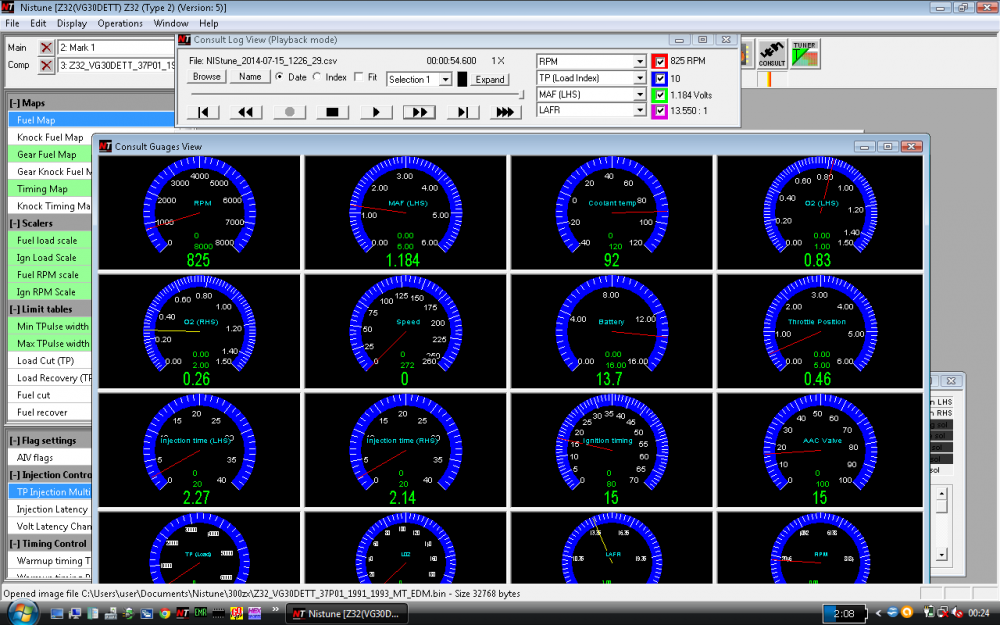
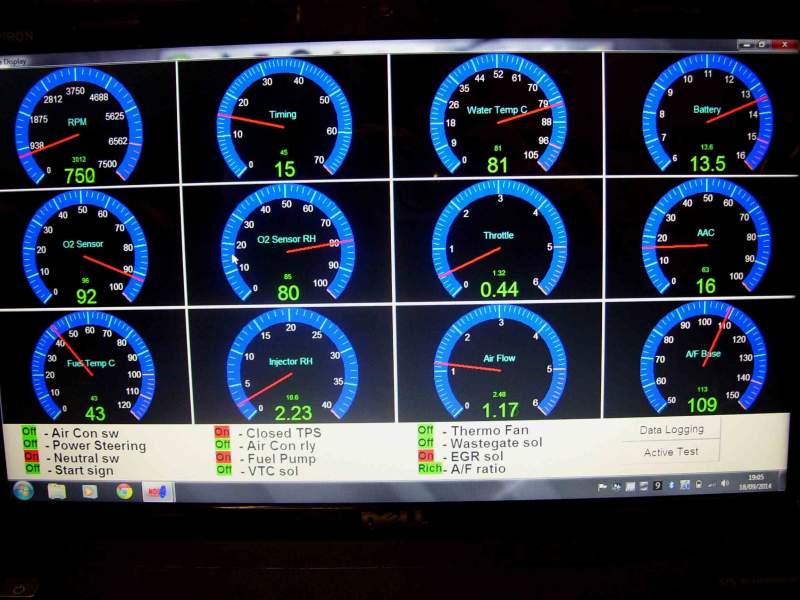
By the way, here is the raw data that goes with that video of my instruments. If anyone can look at the data and let me know if any of the numbers look out of whack. One thing that surprises me is that the time drops back to 19-20 degrees BTDC at full throttle, high boost, whereas slight throttle gets 42 degrees of advance.


ecutalk1392014_video.xlsx


Thanks,


Mark

> Pump ethanol free here is US 91 AKI. I am at 3,300 ft above sea level


and


> 19-20 degrees BTDC at full throttle


These ignition levels with 91AKI fuel might be the cause for your detonation problems..(even at low boost levels) and cause the ECU to switch to safety boost mode.


(temporarily) retard the base timing to 12 or 13 BTDC and see if that helps...if so, you will need a remap (or get better fuel)

  • Author

Last things on the checklist done- checked the injector resistances. What made the job easy was discovering I could do it from the ECU connector, pretty neat that I did not have to try to get all those connectors off (and remove the balance tube).


#1- 12.1 Ohms

#2- 12.3

#3- 12.1

#4- 12.1

#5- 12.1

#6- 12.0


That includes all the resistance in the wire to the injectors, theoretically 0, but what it tells me is the damn injectors are doing what they were designed to.


After eliminating the unlikely, then that leaves only the impossible- my petrol sucks.


Here in Montana all our gasoline comes from a refinery in Billings (about 300 miles from here) and they make 87, 89 and 91* (note below) AKI with 10% ethanol and 91 AKI ethanol free. It is intended for "Snowmobile and off-road use".

* I was told that the refinery makes their Super 93 AKI, because it is also sold in Washington and in the Dakotas. More economical to just make one Super formulation, and sell it both here and at lower elevations. All the pumps here are marked 91 AKI, but because you are getting higher octane than you are paying for it isn't an issue.


I am wondering if I should just give up buying the ethanol-free gas (who knows what they get away with putting into outboard engines and ATVs) and just buy the ethanol-gas blend. Then budget for a set of later-model injectors and the adapter kit when my current ones die from the ethanol.


I have run out of ideas. I think I have checked everything. I will still take the car and have it run the dyno. We'll see if that finds anything, but I can't imagine what.


Maybe I should just take it out behind the barn and shoot the damn thing.

  • Author

Last things on the checklist done- checked the injector resistances. What made the job easy was discovering I could do it from the ECU connector, pretty neat that I did not have to try to get all those connectors off (and remove the balance tube).


#1- 12.1 Ohms

#2- 12.3

#3- 12.1

#4- 12.1

#5- 12.1

#6- 12.0


That includes all the resistance in the wire to the injectors, theoretically 0, but what it tells me is the damn injectors are doing what they were designed to.


After eliminating the unlikely, then that leaves only the impossible- my petrol sucks.


Here in Montana all our gasoline comes from a refinery in Billings (about 300 miles from here) and they make 87, 89 and 91* (note below) AKI with 10% ethanol and 91 AKI ethanol free. It is intended for "Snowmobile and off-road use".

* I was told that the refinery makes their Super 93 AKI, because it is also sold in Washington and in the Dakotas. More economical to just make one Super formulation, and sell it both here and at lower elevations. All the pumps here are marked 91 AKI, but because you are getting higher octane than you are paying for it isn't an issue.


I am wondering if I should just give up buying the ethanol-free gas (who knows what they get away with putting into outboard engines and ATVs) and just buy the ethanol-gas blend. Then budget for a set of later-model injectors and the adapter kit when my current ones die from the ethanol.


I have run out of ideas. I think I have checked everything. I will still take the car and have it run the dyno. We'll see if that finds anything, but I can't imagine what.


Maybe I should just take it out behind the barn and shoot the damn thing.

Apologies for the thread hijack - but I hope the detail on knock / safety boost is at least marginally relevant / interesting. It is to me anyway ;)

1) The knock sensor only looks for det below 3,200 rpm because above that rpm it's too noisy

2) The ECU uses knock maps a) if the sensor detects knock below 3,200 or b) if the knock sensor circuit is inop (Error 34)

=> if you get det over 3,200 rpm and your knock sensor is working, the ECU does NOT go into knock map/safety boost

3) If sensor detects knock, TT uses knock maps (if European/UK - but not JDM/US. Or rather the knock maps for JDM/US are the same as normal) AND goes into safety boost. NA uses knock maps (TT and NA have different maps to begin with, obviously)

4) When does the ECU go back to normal maps/boost? If I have knock below 3,200, knock maps used. The sensor is not used over 3,200 rpm so what happens when I reach those revs?

5) It's odd that there is no code or readout either as normal or even if you're using ECUTalk / ConZult (IIRC) to tell you if the ECU is using safety boost / knock maps.

6) The only way to tell if ECU is using knock maps is by detecting the power difference (which is a tad difficult if you bought a Zed in safety mode already) if you haven't done the LED / buzzer thing posited by Eggs/Noz


Do I have that right, Noz?


When does the High Gear map get used and is it different Man/Auto, by market?


I used faithfully to use VPower in all my Zeds but the last time I did an extended (several months) comparison, there was no discernable (recordable) difference between VPower and ordinary Shell as for mpg so I've not bothered for the past year or so. This is all for stock NA used as daily driver.


1) - 3) Spot on


4) I'm not sure about this. I could investigate by switching the knock sensor output normally whilst driving or on the dyno, but it's not something I have ever thought of investigating. I can hazard a guess, and due to knock hysteresis (it takes a larger reduction in timing to halt detonation than to prevent it in the first place) I *think* the ECU will use the knock maps until the car is switched off and on again. I know that when I had one car that was using the knock maps, once I had deleted the knock DTC and also forced the ECU to ignore knock DTC, I had to switch off & on again for the ECU to be using the regular maps.


5) & 6) Nistune will highlight the maps & tables that the ECU is accessing, so will show exactly when a Zed is using the knock maps.


High gear maps: These are something I disable. There is a coefficient for when the high gear maps are used, when mapping I see them accessed all the time. The main difference is the removal of O2 feedback in part of the map. The JWT map uses the high gear fuelling for 90% of its 'tuned' fuelling map.

Apologies for the thread hijack - but I hope the detail on knock / safety boost is at least marginally relevant / interesting. It is to me anyway ;)

1) The knock sensor only looks for det below 3,200 rpm because above that rpm it's too noisy

2) The ECU uses knock maps a) if the sensor detects knock below 3,200 or b) if the knock sensor circuit is inop (Error 34)

=> if you get det over 3,200 rpm and your knock sensor is working, the ECU does NOT go into knock map/safety boost

3) If sensor detects knock, TT uses knock maps (if European/UK - but not JDM/US. Or rather the knock maps for JDM/US are the same as normal) AND goes into safety boost. NA uses knock maps (TT and NA have different maps to begin with, obviously)

4) When does the ECU go back to normal maps/boost? If I have knock below 3,200, knock maps used. The sensor is not used over 3,200 rpm so what happens when I reach those revs?

5) It's odd that there is no code or readout either as normal or even if you're using ECUTalk / ConZult (IIRC) to tell you if the ECU is using safety boost / knock maps.

6) The only way to tell if ECU is using knock maps is by detecting the power difference (which is a tad difficult if you bought a Zed in safety mode already) if you haven't done the LED / buzzer thing posited by Eggs/Noz


Do I have that right, Noz?


When does the High Gear map get used and is it different Man/Auto, by market?


I used faithfully to use VPower in all my Zeds but the last time I did an extended (several months) comparison, there was no discernable (recordable) difference between VPower and ordinary Shell as for mpg so I've not bothered for the past year or so. This is all for stock NA used as daily driver.


1) - 3) Spot on


4) I'm not sure about this. I could investigate by switching the knock sensor output normally whilst driving or on the dyno, but it's not something I have ever thought of investigating. I can hazard a guess, and due to knock hysteresis (it takes a larger reduction in timing to halt detonation than to prevent it in the first place) I *think* the ECU will use the knock maps until the car is switched off and on again. I know that when I had one car that was using the knock maps, once I had deleted the knock DTC and also forced the ECU to ignore knock DTC, I had to switch off & on again for the ECU to be using the regular maps.


5) & 6) Nistune will highlight the maps & tables that the ECU is accessing, so will show exactly when a Zed is using the knock maps.


High gear maps: These are something I disable. There is a coefficient for when the high gear maps are used, when mapping I see them accessed all the time. The main difference is the removal of O2 feedback in part of the map. The JWT map uses the high gear fuelling for 90% of its 'tuned' fuelling map.

Last things on the checklist done- checked the injector resistances. What made the job easy was discovering I could do it from the ECU connector, pretty neat that I did not have to try to get all those connectors off (and remove the balance tube).


#1- 12.1 Ohms

#2- 12.3

#3- 12.1

#4- 12.1

#5- 12.1

#6- 12.0


That includes all the resistance in the wire to the injectors, theoretically 0, but what it tells me is the damn injectors are doing what they were designed to.


After eliminating the unlikely, then that leaves only the impossible- my petrol sucks.


Here in Montana all our gasoline comes from a refinery in Billings (about 300 miles from here) and they make 87, 89 and 91* (note below) AKI with 10% ethanol and 91 AKI ethanol free. It is intended for "Snowmobile and off-road use".

* I was told that the refinery makes their Super 93 AKI, because it is also sold in Washington and in the Dakotas. More economical to just make one Super formulation, and sell it both here and at lower elevations. All the pumps here are marked 91 AKI, but because you are getting higher octane than you are paying for it isn't an issue.


I am wondering if I should just give up buying the ethanol-free gas (who knows what they get away with putting into outboard engines and ATVs) and just buy the ethanol-gas blend. Then budget for a set of later-model injectors and the adapter kit when my current ones die from the ethanol.


I have run out of ideas. I think I have checked everything. I will still take the car and have it run the dyno. We'll see if that finds anything, but I can't imagine what.


Maybe I should just take it out behind the barn and shoot the damn thing.


Or.....


Oh, I have actually read through your issues, here: http://www.300zx.co.uk/forums/showthread.php?178668-Detonation-issues-have-I-found-the-answer&p=1839135#post1839135


You've covered quite a lot of the points I suggested in the previous post, nice one :)


Right. How do you know it's actually detonating? As far as I'm aware, you've not monitored knock using suitable equipment (det cans and aftermarket knock analyser), and you're simply going on the OEM knock sensor. They're not very clever components, so if I may suggest you take it to a reputable dyno operator (he doesn't need to be a Zed specialist) and ask him to monitor knock levels with the appropriate equipment. A Zed dropping into safety boost does not mean the engine is knocking. If you can't take it to a dyno, one thing you can do yourself is reduce the base timing by 10° and see if it still drops into safety boost. Not a definitive test, mind.


Are you running a standard OEM ECU?


Running it on a dyno will tell you exactly what you need to know: Specifically, what AFR it is running throughout, and the level of knock as monitored by a professional.


Just get a Nistune board in your ECU plus a wideband AFR guage and I can map it remotely based on the logs you take :cool3:

Edited by Noz

Last things on the checklist done- checked the injector resistances. What made the job easy was discovering I could do it from the ECU connector, pretty neat that I did not have to try to get all those connectors off (and remove the balance tube).


#1- 12.1 Ohms

#2- 12.3

#3- 12.1

#4- 12.1

#5- 12.1

#6- 12.0


That includes all the resistance in the wire to the injectors, theoretically 0, but what it tells me is the damn injectors are doing what they were designed to.


After eliminating the unlikely, then that leaves only the impossible- my petrol sucks.


Here in Montana all our gasoline comes from a refinery in Billings (about 300 miles from here) and they make 87, 89 and 91* (note below) AKI with 10% ethanol and 91 AKI ethanol free. It is intended for "Snowmobile and off-road use".

* I was told that the refinery makes their Super 93 AKI, because it is also sold in Washington and in the Dakotas. More economical to just make one Super formulation, and sell it both here and at lower elevations. All the pumps here are marked 91 AKI, but because you are getting higher octane than you are paying for it isn't an issue.


I am wondering if I should just give up buying the ethanol-free gas (who knows what they get away with putting into outboard engines and ATVs) and just buy the ethanol-gas blend. Then budget for a set of later-model injectors and the adapter kit when my current ones die from the ethanol.


I have run out of ideas. I think I have checked everything. I will still take the car and have it run the dyno. We'll see if that finds anything, but I can't imagine what.


Maybe I should just take it out behind the barn and shoot the damn thing.


Or.....


Oh, I have actually read through your issues, here: http://www.300zx.co.uk/forums/showthread.php?178668-Detonation-issues-have-I-found-the-answer&p=1839135#post1839135


You've covered quite a lot of the points I suggested in the previous post, nice one :)


Right. How do you know it's actually detonating? As far as I'm aware, you've not monitored knock using suitable equipment (det cans and aftermarket knock analyser), and you're simply going on the OEM knock sensor. They're not very clever components, so if I may suggest you take it to a reputable dyno operator (he doesn't need to be a Zed specialist) and ask him to monitor knock levels with the appropriate equipment. A Zed dropping into safety boost does not mean the engine is knocking. If you can't take it to a dyno, one thing you can do yourself is reduce the base timing by 10° and see if it still drops into safety boost. Not a definitive test, mind.


Are you running a standard OEM ECU?


Running it on a dyno will tell you exactly what you need to know: Specifically, what AFR it is running throughout, and the level of knock as monitored by a professional.


Just get a Nistune board in your ECU plus a wideband AFR guage and I can map it remotely based on the logs you take :cool3:

Edited by Noz

@madkiwi - that's two experts advising to temporarily retard base timing and see if safety boost occurs. I've not met Noz but I have met lymon and followed his advice before - since they agree, for me it would be a no-brainer.

@noz - ta. Given what is known / measurable "I *think* the ECU will use the knock maps until the car is switched off and on again. " makes sense and is a reasonable hypothesis. Wouldn't make sense for the ECU to switch in and out of maps at 3,200 (which is what it would do if it only monitored knock circuit realtime).

  • Author
@madkiwi - that's two experts advising to temporarily retard base timing and see if safety boost occurs. I've not met Noz but I have met lymon and followed his advice before - since they agree, for me it would be a no-brainer.


I am going to do that, tomorrow when I have 20 minutes to deal with it.


But Noz, if you are still reading- something new happened today. After a normal start to my day I made my first stop, and when I returned to the car a few minutes later and started it, the idle jumped to 1500 rpm, then stepped down slowly over the next 5 or 6 minutes to normal idle (800 rpm). Thought that was a little weird, stopped at the next place I had to go, and the same thing when I got back in the car.


After the 3rd time this happened, I plugged in my laptop to the Consult plug. Turned on the ignition and the coolant temp was showing it was 70 degrees (21 Celcius). This was after the car was sitting for only 20 minutes, and it was an 80 degree day. I started the engine, same wildly high rpms, and I sat in the parking lot until the temp on the computer showed it was 176 F (80 C), took about 5 minutes. Idle was where it should be after car is warmed up.


Drove to my next stop, computer showing temp around 180 F, shut car down. Turned key to ON position, temp on the computer showed 75 F. Started the car, idle ran to 1500 rpm, then ran down to 0. Yes, for the first time since I purchased the car 4 years ago, the engine stalled. Transmission in Park. Started it again, and the car was in "cold start" mode again, with high idle, but it stayed running.


Drove home, idle is a little high, 900 rpm, temp on laptop showing 178 F. Shut down when I got home, started the engine again, and once again it stalled. Stayed running the second time I started it.


Checked codes, of course it is Code 13, CTS. But that doesn't explain the symptoms- I had a bad coolant sensor when I purchased the car and the auxiliary fan ran all the time. Idle was a little high, but not 1500 rpm. The CTS and the connector were replaced together, and I definitely soldered the new connector. I did a full temperature test of the CTS about 6 weeks ago, it passed with flying colors.


Thoughts?

I've never tried this with the coolant temp sensor, but with the fuel temp sensor unplugged, the fuel temp starts at around 20°C and slowly increases to the maximum (80°C IIRC), all the while throwing code 42. The moment it is reconnected, the fuel temp reads correctly. Unplug it again, it immediately shows 20°C and slowly increases again to the maximum.


If one moment the ECU is seeing the correct voltage/temperature (eg 80°C), and the next moment it is seeing 21°C, then maybe the voltage differential forces an error code. It may well be more sophisticated than the simple open/closed circuit error reporting. I take it when the issues are occurring, the aux fan is not on?


When the coolant is at a genuine 80°C, and the ECU is seeing 20°C, the car will naturally idle at 1500RPM, as the timing & fuelling are both increased a lot in this scenario. I guess the only thing you can do is test the sensor again as per the manual, ensure the connections are sound and there are no breaks in the associated loom.

Edited by Noz

  • Author

I'll strip down the plug connections and make sure the splices are good. Actually even if they are, I have a new yellow connector w/pigtails in my parts box, I will just replace it. Then connect my multi-tester to ECU connector pins 28 and 30 and make sure I get good readings.


Thinking out loud now- maybe this has been my problem all along? A bad connection or not-quite-good-enough connection that has been flaking out randomly, telling the ECU that the engine is too cold for boost? Maybe not, once the engine sees higher temps again, then it would allow boost. So, never mind. Plus I have not recorded any CTS codes before.


I'll let you know what I find tomorrow.


Mark

  • Author

Oh, and the aux. fan did not come on. Sorry, overlooked answering your question.

  • Author

Well that is a new one to me. Not only is the CTS bad, it is completely open. No resistance at all. Wiring checks out fine (total resistance was 0.2 Ohms).


I wonder why that just happened.


I know you in the UK complain about Nissan raping you on parts, but we get some of that here. MSRP on a CTS is $29.75. My local stealership has one in stock, they want $35.70 (Courtesy Nissan has them for $22.31).


I want to get the car running today, so pay I must. Can't wait 3-5 days for Courtesy to send it to me.


Oh, I called the place that has a dyno here in town. They specialize in diesel truck stuff. The tech basically told me unless I have my own knock monitoring equipment and software, there is nothing they can or will do for me. So that is a dead end.

Are the knocking & safety boost issues cured now then?


If not, let us know how it goes with a reduction in base timing.


If the dyno really is a no-go, and the knocking is still occurring, one option would be to program a series of chips for you with differing fuel/timing maps based on whatever map is in your ECU. Old-school remote mapping :D

  • Author

Got home too late to install the new CTS, let alone go for a test drive. It is supposed to be 85 F tomorrow (29.4 C) so a great day for seeing if the detonation comes back.


What do I need to incorporate the Nistune stuff in my car?

Got home too late to install the new CTS, let alone go for a test drive. It is supposed to be 85 F tomorrow (29.4 C) so a great day for seeing if the detonation comes back.


What do I need to incorporate the Nistune stuff in my car?


Nistune daughterboard plugs into the 28pin chip socket, then there's a 4-wire ribbon to solder to the ECU and connect to the Nistune board.

Nistune software licence if you're going to be tinkering. Not sure of the current capabilities of the free trial version. Download it from the website and check it out :)

Consult diagnostic cable. I use serial ones.


Required for tuning:

Wideband lambda sensor

Knock monitoring equipment

  • Author

If it isn't one thing, it's another. I replaced the CTS (checked the new one was within specs first) and started the car, it was running like crap. Dragged out the laptop, plugged it in, pulled codes. Code 21- No ignition signal. Tried a power balance test, #4 is not running.


Only thing I can think of is that when I was manipulating the harness to replace the CTS plug I must have either broken a wire or dislodged one of the PTU connectors. Because if the PTU is actually bad I MUST be cursed. I did not have time beyond step one of the diagnostic procedure (EF & EC 119-121) to trouble-shoot. I work for myself, but I had to go take care of work stuff and so... tomorrow.


Ever seen a grown man cry? I came close...

  • Author

Today I checked the wiring between coilpack #4 and the PTU, good continuity. The connector between the harness and the PTU was green, used a bunch of electronics cleaner and a Dremel to clean up the contacts. Going to check the wiring between the PTU and the ECU tomorrow. Wondering if the ECU connector pin is not making contact. The first Google search I did for "300ZX code 21" came up with a thread on 300zxclub.com where the guy's problem was the female connector on the ECU harness connector backed out of the plug.


I did have the ECU disconnected the day before the new CTS came in, when I was checking the wiring of my new CTS plug.


After I make sure the wiring/connectors from the ECU to PTU is good, then I will test the PTU. See what I am doing? Check the inexpensive stuff first. A PTU here is $158, don't want to assume it is knackered until proven so.

  • Author

I am such a retard.


You know how they say be careful when you are reconnecting the ECU connector to the ECU? Don't over-tighten the bold that holds it on?


Well, don't UNDERTIGHTEN it either. Because if the connector isn't fully seated, then weird things happen- like pin 11 that feeds ignition signal for coil #4 to the PTU doesn't connect properly.


Obviously I discovered this AFTER troubleshooting the PTU, the ECU-PTU harness and finding absolutely nothing wrong. Until I started reconnecting the ECU and realizing I was tightening it more than I had previously... OH ****ING HELL!


On the plus side, all the PTU connectors are now clean and full of dielectric grease.

  • 3 weeks later...
  • Author

So here is the latest on my progress (or lack thereof).


I had the compression tested, high was 171 and low was 148 psi. Like a new engine. Verified that the mark on the crank pulley lined up with 0 on the advance indicator when #1 was at TDC. With the plugs out for the compression test my mechanic inspected the cylinders with a borescope. Apart from normal carbon deposits, nothing to report.


I can report that the FSM manual has an error in the testing protocol for the MAF. On page EF & EC 174 it says that voltage from b to ground with the key ON should be about 0.8 volts. I purchased a used N62 sensor last week and installed it, it has a voltage of 0.45 volts and my old one was 0.44. Both show the expected voltage at idle (1.216 and 1.245). And it did nothing to solve my safety boost problem.


I just ran a tank of gas with a bottle of Redline Si-1 fuel system cleaner in it to clean up the injectors/valves. Happy to report that it has already helped my fuel economy a bit, just got the highest mpg in mixed driving in a long time (17.59 mpg, or 13.37 l/100km) but still getting the safety boost issue.


I have not changed the base timing to 12 degrees (or lower) as suggested yet because I have been doing other things and seeing if they help first. Don't want to change a bunch of things at once and not know which one made the difference.


Is there a way to examine the fuel maps programmed into the JWT ECU without spending a fortune on software? Because with the lack of anything else I am wondering if there is something wrong in the ECU. On twinturbo.net someone did say that a tuner had found an issue with a 1995 dated JWT chip that was running super-lean. I am not sure what the date is on mine, short of pulling the carpet/plywood out of the passenger footwell, which I don't feel like dealing with right now. I will before my next phone call to JWT, because I may have to ask them about it.


Thanks.

Join the conversation

You can post now and register later. If you have an account, sign in now to post with your account.

Guest
Unfortunately, your content contains terms that we do not allow. Please edit your content to remove the highlighted words below.
Reply to this topic...

Recently Browsing 0

  • No registered users viewing this page.

Important Information

Terms of Use

Account

Navigation

Search

Configure browser push notifications

Chrome (Android)
  1. Tap the lock icon next to the address bar.
  2. Tap Permissions → Notifications.
  3. Adjust your preference.
Chrome (Desktop)
  1. Click the padlock icon in the address bar.
  2. Select Site settings.
  3. Find Notifications and adjust your preference.