Jump to content
View in the app

A better way to browse. Learn more.

300ZX Owners Club

A full-screen app on your home screen with push notifications, badges and more.

To install this app on iOS and iPadOS
  1. Tap the Share icon in Safari
  2. Scroll the menu and tap Add to Home Screen.
  3. Tap Add in the top-right corner.
To install this app on Android
  1. Tap the 3-dot menu (⋮) in the top-right corner of the browser.
  2. Tap Add to Home screen or Install app.
  3. Confirm by tapping Install.

Engine sensor recordings- help interpret

This is what I recorded yesterday using ECUtalk. I edited the video down to 4:15, just from the time I got on the interstate and exited again.


Apologies for all the clicking picked up by the microphone, the only thing I can think is it was rubbing on the leather seat?


I think everything looks normal. Car did not go into safety boost, which is what I was hoping I would get so I could record what the engine was doing when it occurs. My theory of a faulty MAF seems to be disproved by this recording, at 6,000 rpm with 3.26 volts on the throttle (and about 10.5 psi boost) the MAF was at 4.16 v (this is at approx. 110 mph, in 3rd gear- automatic transmission). However, the MAF was showing a bad reading with the ignition ON (engine not running) of 0.44 with a voltmeter, ECUTalk recorded 0.08 volts. Service manual says it should be 0.8 volts.


ECUTalk could not read the speed, I believe the consult adapter I got on Ebay is faulty. It also causes a code 14 Speed sensor fault, and sets off the HICAS warning light, and to make things just peachy it puts the power steering into "high speed mode"- fine for the freeway, not so great on city streets. Removing the consult adapter from the vehicle's plug restores everything to normal. So I am asking the seller for a replacement adapter, assuming this one has some kind of internal short.


Also did a power balance test when I got home using OBD Scantech. Got an rpm drop on every cylinder, so presuming I have no misfires (at idle anyway). Is it worth re-running the balance test at higher rpm (I saw that as an option)?


Power Balance Test Summary On 9/13/2014 5:08:33 PM

Coolant Temperature: 189 Deg {F}

Idle Air: 24 %


Cylinder # 1

Cylinder On Stablized For 2 Seconds

Average RPM When Cylinder Stablized... 845 Rpm

Cylinder Off Sampled For 3 Seconds

Average RPM When Cylinder Is Off... 802 Rpm

Average RPM Drop Result... 43 Rpm

Highest RPM Drop... 95 Rpm

Amount Of Data Sampled When Cylinder Off... 182


Cylinder # 2

Cylinder On Stablized For 2 Seconds

Average RPM When Cylinder Stablized... 869 Rpm

Cylinder Off Sampled For 3 Seconds

Average RPM When Cylinder Is Off... 827 Rpm

Average RPM Drop Result... 42 Rpm

Highest RPM Drop... 69 Rpm

Amount Of Data Sampled When Cylinder Off... 187


Cylinder # 3

Cylinder On Stablized For 2 Seconds

Average RPM When Cylinder Stablized... 877 Rpm

Cylinder Off Sampled For 3 Seconds

Average RPM When Cylinder Is Off... 817 Rpm

Average RPM Drop Result... 60 Rpm

Highest RPM Drop... 114 Rpm

Amount Of Data Sampled When Cylinder Off... 191


Cylinder # 4

Cylinder On Stablized For 2 Seconds

Average RPM When Cylinder Stablized... 873 Rpm

Cylinder Off Sampled For 3 Seconds

Average RPM When Cylinder Is Off... 815 Rpm

Average RPM Drop Result... 58 Rpm

Highest RPM Drop... 110 Rpm

Amount Of Data Sampled When Cylinder Off... 186


Cylinder # 5

Cylinder On Stablized For 2 Seconds

Average RPM When Cylinder Stablized... 864 Rpm

Cylinder Off Sampled For 3 Seconds

Average RPM When Cylinder Is Off... 817 Rpm

Average RPM Drop Result... 47 Rpm

Highest RPM Drop... 76 Rpm

Amount Of Data Sampled When Cylinder Off... 185


Cylinder # 6

Cylinder On Stablized For 2 Seconds

Average RPM When Cylinder Stablized... 869 Rpm

Cylinder Off Sampled For 3 Seconds

Average RPM When Cylinder Is Off... 817 Rpm

Average RPM Drop Result... 52 Rpm

Highest RPM Drop... 106 Rpm

Amount Of Data Sampled When Cylinder Off... 186


Can anyone tell me if this is all normal?


Thanks,


Mark

(Crossposted to every 300zx forum I am a member of)

  • Replies 80
  • Views 6.4k
  • Created
  • Last Reply

Top Posters In This Topic

Posted Images

Featured Replies

I've not read everything about your issues (not the crack smoking, the detonation), so apologies in advance if I repeat something as the follwing is just a general checklist.


If you're detonating, then it will be due to one or more the following issues:


Spark plug rating too hot

Incorrect base timing

Faulty CAS


Fuel delivery issue (eg. weak pump, blocked injectors)

Low grade fuel


Carbon build up on piston crowns

Compression too high (skimmed heads, NA engine)

Lowered fuel RON due to oil ingestion


Poorly mapped ECU (timing set too advanced; fuelling set too lean)


Too much boost

Intake charge temps too high


Go through the above list. Discount what doesn't apply. Investigate what does. Get it on a dyno and monitor AFR & knock.

Oh, I have actually read through your issues, here: http://www.300zx.co.uk/forums/showthread.php?178668-Detonation-issues-have-I-found-the-answer&p=1839135#post1839135


You've covered quite a lot of the points I suggested in the previous post, nice one :)


Right. How do you know it's actually detonating? As far as I'm aware, you've not monitored knock using suitable equipment (det cans and aftermarket knock analyser), and you're simply going on the OEM knock sensor. They're not very clever components, so if I may suggest you take it to a reputable dyno operator (he doesn't need to be a Zed specialist) and ask him to monitor knock levels with the appropriate equipment. A Zed dropping into safety boost does not mean the engine is knocking. If you can't take it to a dyno, one thing you can do yourself is reduce the base timing by 10° and see if it still drops into safety boost. Not a definitive test, mind.


Are you running a standard OEM ECU?

Edited by Noz

  • Author

I was so hopeful I had it figured out. My MAF failed one of the Service Manual tests, so shouldn't it be assumed it is bad? My ON (engine not running) voltage was measured at 0.44 volts, manual says it should be 0.8 volts. Removed and cleaned it, same result. What is really weird is ECUTalk shows the not running voltage as 0.08 volts. My running at idle voltage was 1.245 V (manual says it should be 0.8 to 1.5).


I have stock turbos, with the JWT ECU and 12.5-13.5 psi boost jets.


What else would cause safety boost? I thought it was only 4 things-


-Engine is cold

-Bad Engine Temperature sensor

-Car is detonating

-Bad detonation sensor


Engine not cold when it happens, Temp sensor was checked and is good, detonation sensor replaced last year. NO CODES! Everything is Code 55.


I am still stumped.

I was so hopeful I had it figured out. My MAF failed one of the Service Manual tests, so shouldn't it be assumed it is bad? My ON (engine not running) voltage was measured at 0.44 volts, manual says it should be 0.8 volts. Removed and cleaned it, same result. What is really weird is ECUTalk shows the not running voltage as 0.08 volts. My running at idle voltage was 1.245 V (manual says it should be 0.8 to 1.5).


I have stock turbos, with the JWT ECU and 12.5-13.5 psi boost jets.


What else would cause safety boost? I thought it was only 4 things-


-Engine is cold

-Bad Engine Temperature sensor

-Car is detonating

-Bad detonation sensor


Engine not cold when it happens, Temp sensor was checked and is good, detonation sensor replaced last year. NO CODES! Everything is Code 55.


I am still stumped.


Oh, I have actually read through your issues, here: http://www.300zx.co.uk/forums/showthread.php?178668-Detonation-issues-have-I-found-the-answer&p=1839135#post1839135


You've covered quite a lot of the points I suggested in the previous post, nice one :)


Right. How do you know it's actually detonating? As far as I'm aware, you've not monitored knock using suitable equipment (det cans and aftermarket knock analyser), and you're simply going on the OEM knock sensor. They're not very clever components, so if I may suggest you take it to a reputable dyno operator (he doesn't need to be a Zed specialist) and ask him to monitor knock levels with the appropriate equipment. A Zed dropping into safety boost does not mean the engine is knocking. If you can't take it to a dyno, one thing you can do yourself is reduce the base timing by 10° and see if it still drops into safety boost. Not a definitive test, mind.


Are you running a standard OEM ECU?


You have eliminated 3 out of 4 possibilities in your list (engine is cold, bad engine temp sensor, bad detonation sensor). Now, you need to determine if the car is actually knocking or not. To be blunt: Nothing else matters. There is no Nissan manual for this, you need the expertise of someone that tunes cars. Doesn't matter if they've never even seen a Zed before. It will require several high load pulls in order to monitor the effect of heat soak. Put me on a plane and I will sort it for you in about 1hr. I need a holiday.


Once you've determined if it is detonating or not, then you can start investigating the cause of the detonation, or the dodgy knock sensor/wiring. You're doing it arse about face as it stands. Forget the fact that it is a 300ZX, that is not important. It is simply a forced-induction internal combustion engine that may or may not be detonating. Forget the manuals, forget Consult/ECUtalk and cute little voltage readouts. How long has this issue been ongoing for? I would be aiming to solve similar issues in about 1hr on a mildly-modified car I have never seen before. Not because I'm anything special, but because I know the correct sequence for diagnosing issues such as this, and use the correct tools.


This guy said it best:

I don't know who you are. I don't know what you want. If you are looking for pleasantries, I can tell you I don't have tact. But what I do have are a very particular set of skills, skills I have acquired over a very long career. Skills that make me a blessing for people like you. If you take your Zed to a dyno, that'll be the end of it. I will not look for you, I will not pursue you. But if you don't, I will look for you, I will find you, and I will fix your Zed (at your expense).


For future reference to those interested: If you think your car (Zed, or otherwise) may be detonating, have it monitored properly first & foremost before doing anything else.

Edited by Noz

  • Author

Wish I had the resources to fly you out here. I know there is one shop in town that has a dyno. I will call tomorrow and see what they can do.


I actually heard the detonation a couple times, right as the safety boost kicked in. I am familiar with what it sounds like, owning a Pathfinder teaches you that. At first I really thought it was loose change rattling in the ashtray.


Getting back to your comments about setting the AAC to 15%, how exactly is this accomplished? Neither of the software packages I have (ECUTalk and OBD Scan Tech) have the ability to change anything there. Is it just a matter of adjusting the idle screw while monitoring the AAC on the software?


Forgive my ignorance, not a mechanic by trade and getting help in this 1 horse town is frustrating when they all know less than I do.


Thank you for taking the time to even help.

Yes, setting the AAC to 15% is accomplished by adjusting the base idle screw.

Leave everything connected and make sure the engine is at full running temperature.

You may need to wait a minute or so for the readings to react.

Wish I had the resources to fly you out here. I know there is one shop in town that has a dyno. I will call tomorrow and see what they can do.


I actually heard the detonation a couple times, right as the safety boost kicked in. I am familiar with what it sounds like, owning a Pathfinder teaches you that. At first I really thought it was loose change rattling in the ashtray.


Getting back to your comments about setting the AAC to 15%, how exactly is this accomplished? Neither of the software packages I have (ECUTalk and OBD Scan Tech) have the ability to change anything there. Is it just a matter of adjusting the idle screw while monitoring the AAC on the software?


Forgive my ignorance, not a mechanic by trade and getting help in this 1 horse town is frustrating when they all know less than I do.


Thank you for taking the time to even help.


Ah, so it's loud det. Ok, so working on the assumption it has severe detonation if you're confident you've heard it, how long has it done it for? Any correlation with when the chip & boost jets were fitted? Reduce the base timing and see if it cures the knock. It's far from ideal as it's a blanket reduction in timing, but it's a 5 minute job and will make it safer to drive as well. It could be the MAF under-reading, you need to see what load values the ECU is accessing. Nistune software will do this. I can't remember if the demo version has the realtime capabilities activated.


AAC:

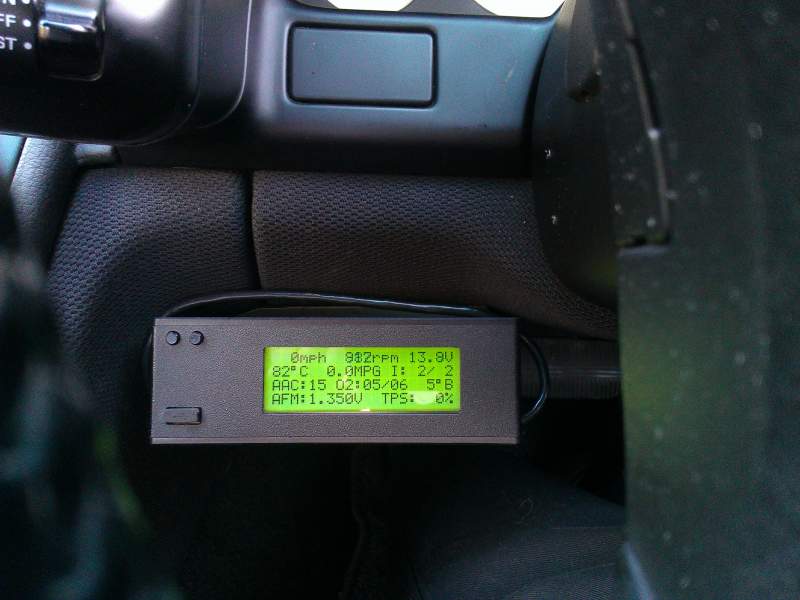
Car up to temp, all electrical systems off. It's a mechanical adjustment of the AAC screw, diagnostic software for monitoring only. Adjust it so it hits 16%, then adjust a tiny bit further so it *just* drops to 15%. Reason for this is that it can be showing 15%, but be too far open. Rev the car a couple of times and monitor the response to ensure it just drops to 15% every time.


More than happy to help where I can :)

Sorry Madkiwi, I hope you don not mind a slight post hi jack.


Noz, Would you cast your eye over these reeading please?

Data Scan AAC settings.jpg

Given Noel's comment and gonna be cheeky and say your AAC should be 15 lol

Membership No 0780

INSURANCE GOOFA

Datascan, Conzult, ECUTalk and a few others

I have all the rare bits you can't find :tongue::tongue:


I think it can also look at the HICAS,AIR BAG and A-F mixture. (Subject to a wide band O2 sensor being fitted)

It is being updated regularly but I have not checked for updates this year.

Sorry Madkiwi, I hope you don not mind a slight post hi jack.


Noz, Would you cast your eye over these reeading please?


Get it on 15% before your engine holes a piston! Quick!


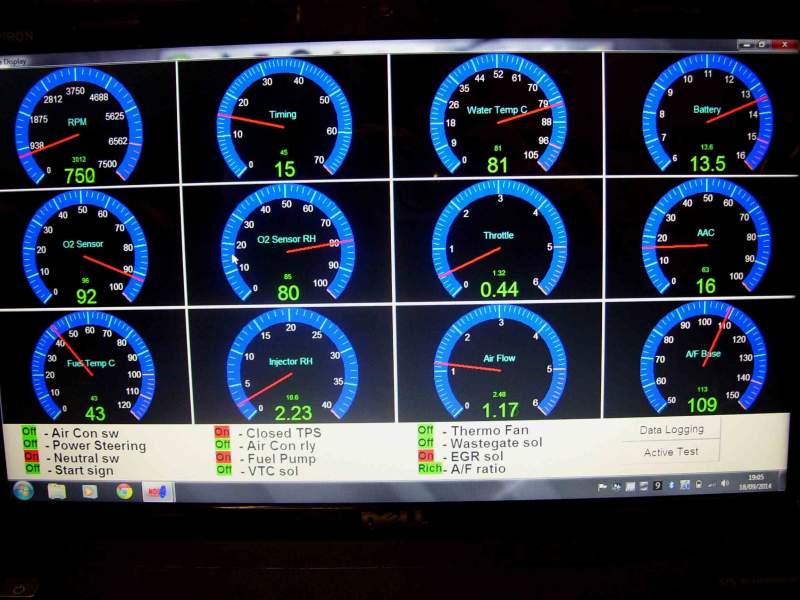
OK then, major assumption I'm making here is that those values are in a stable condition, say after 1 minute of idling at the very least. If not, the following observations are pretty worthless :D


The O2 sensor reading is in %, so 0% is 0v and 100% is 1.5V (1500mV). The switching voltages are at 0.48V (32%, falling) to force the AFR rich (14.7:1) during a rich condition. This is lambda feedback. RH Pulsewidth looks a bit high at 2.23ms hence the 92% & 80% O2 values (plus the "rich" flag of course). I would expect LH pulsewidth to be higher than RH. Air Flow % is typical for idle condition. At idle, the stock map has an estimated pulsewidth of around 1.5ms, interpolated from 4 load/RPM points. But this is overruled by lambda feedback. I see typical values around 1.9ms.


Fuel temp at 43° so I would guess the car has been idling with the bonnet down for around 10 mins after getting up to temp, or with the bonnet up for around 15 mins. Ambient temp approximately...... Lol, just kidding! :wack:


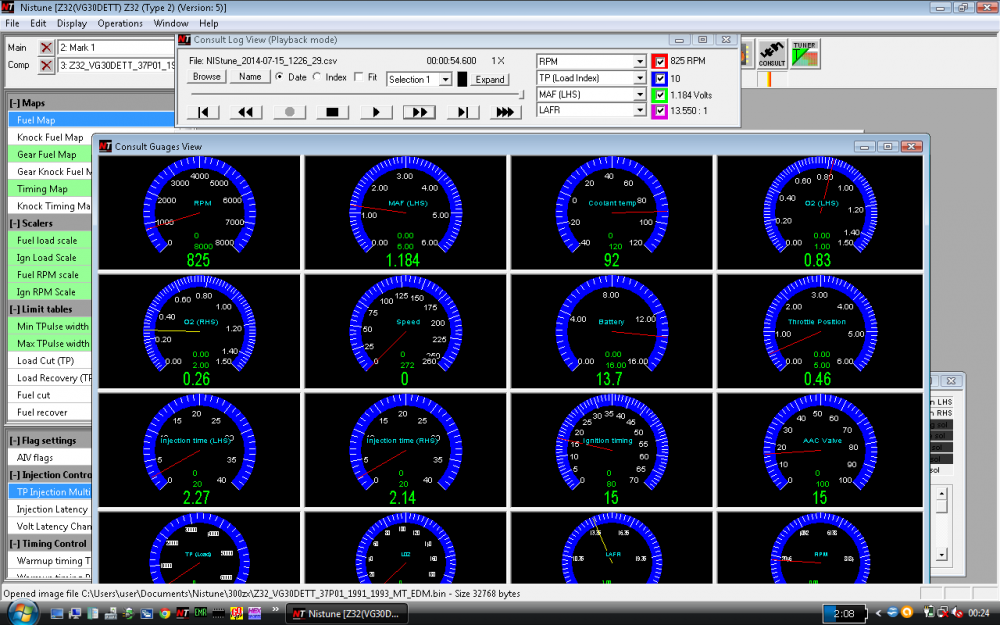
Below is a Zed at idle with a faulty RHS O2 sensor. You can see that the LHS O2 reading is at 830mv (rich condition, lambda trying to force the AFR lean). The LHS pulsewidth is 2.27ms. However, what I have is a realtime AFR readout, denoted LAFR, showing 13.55:1, which is a rich condition.


I would expect your car to be idling around the same AFR at the time that screenshot was taken. Not due to faulty lambdas though. If the O2 sensors were constantly low, the ECU thinks the AFR is less than 14.7:1, and so extra fuel is injected. This is why it's OK to unplug O2 sensors as they sit at 0.31v (which is less than 0.48V) and so the resultant AFR is always going to be richer than 14.7:1.


In your case, the lambda sensors are seeing a genuinely rich condition (voltage > 0.53V/35.3%), so the ECU should be pulling fuel by reducing the pulsewidth, then when AFR gets lean enough to reduce the O2 voltage to 0.48V (32%), the ECU will add fuel to try and keep AFR stoich, and so on ad infinitum. You can see now why if they're not stable values, I've written an essay for no reason!


Idle Condition.png

Edited by Noz

If the knock sensor was detecting detonation, would it not show up in the error codes? So has the knock sensor been bypassed?

If the knock sensor is not bypassed, if it was faulty, would it not show up in the codes?

Reason for asking is that if the knock sensor is fitted and working as Nissan intended, and the ECU Error codes do not show it's been triggered, maybe whatever the guy is seeing isn't detonation?

If the knock sensor has been bypassed than the above does not apply, of course.

If the knock sensor was detecting detonation, would it not show up in the error codes? So has the knock sensor been bypassed?

If the knock sensor is not bypassed, if it was faulty, would it not show up in the codes?

Reason for asking is that if the knock sensor is fitted and working as Nissan intended, and the ECU Error codes do not show it's been triggered, maybe whatever the guy is seeing isn't detonation?

If the knock sensor has been bypassed than the above does not apply, of course.


Error code 34 only shows up due to a faulty knock sensor or associated loom. Detonation doesn't trigger a fault code.


Open circuit or closed circuit will trigger code 34, 1MΩ resistor replicates a knock sensor, don't know how far out of spec before a fault code is triggered.

So, the function of the knock sensor is to put the car into safty boost?


Yes, pretty much. It will trigger the ECU to use the knock maps for fuel & timing, and activate the safety boost solenoids.


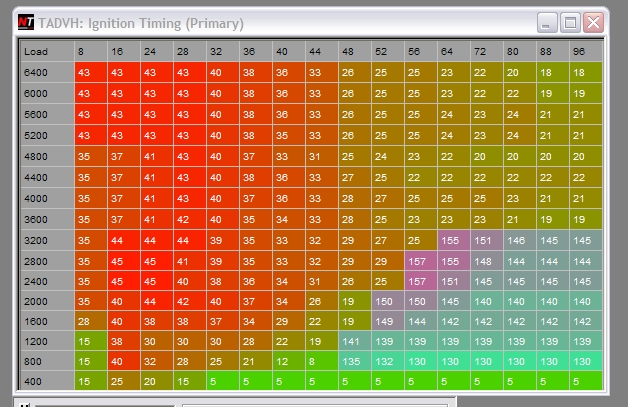
Below is the stock OEM European timing map (already uploaded by myself in another thread elsewhere). The highlighted locations are where knock sensing is active. So fairly high load up to 3200RPM. As is often the case with a 20+yr old Zed, they are a lot more trouble than they're worth. Any knock events above 3200 RPM and it does nothing. Reason for this is that the piezo sensor cannot differntiate between actual knock (6.6kHz for stock 87mm pistons) and engine noise/vibration. A large section of the knock area isn't even accessible by the engine due to boost threshold.


It is important to know that Error Code 34 will force the ECU to access the knock maps and safety boost conditions 100% of the time, not just where the knock sensing is activated. It is a "failsafe" that operates a blanket condition.


The system is implemented mainly as a safeguard against your average Joe using the wrong grade of fuel. A modified Zed with a suitable map has absolutely no need for the stock system at all, for various reasons not in the scope of this thread.


Z32 EDM Timing.jpg

It is important to know that Error Code 34 will force the ECU to access the knock maps and safety boost conditions 100% of the time, not just where the knock sensing is activated. It is a "failsafe" that operates a blanket condition.


Right, so I understand that the 34 code reflects the state of the detonation sensor circuit as opposed to the instance of detonation.

1) How do you know that you're in safety boost (I ask for historical reasons as that happened to my first Zed and then replaced the knock sensor. That's the last time I go to JAE. Thanks Eric :D )

2) How does this apply to NAs? Obviously no safety boost but does it do anything else?

If an engine is running an aftermarket boost controller the knock sensor becomes redundant right? Would it be possible to use the signal from the ECU that would normally trigger the safety boost solenoids to instead light an LED or sound a warning buzzer instead?

Join the conversation

You can post now and register later. If you have an account, sign in now to post with your account.

Guest
Unfortunately, your content contains terms that we do not allow. Please edit your content to remove the highlighted words below.
Reply to this topic...

Recently Browsing 0

  • No registered users viewing this page.

Important Information

Terms of Use

Account

Navigation

Search

Configure browser push notifications

Chrome (Android)
  1. Tap the lock icon next to the address bar.
  2. Tap Permissions → Notifications.
  3. Adjust your preference.
Chrome (Desktop)
  1. Click the padlock icon in the address bar.
  2. Select Site settings.
  3. Find Notifications and adjust your preference.