
Jump to content
View in the app

A better way to browse. Learn more.

300ZX Owners Club

A full-screen app on your home screen with push notifications, badges and more.

To install this app on iOS and iPadOS
  1. Tap the Share icon in Safari
  2. Scroll the menu and tap Add to Home Screen.
  3. Tap Add in the top-right corner.
To install this app on Android
  1. Tap the 3-dot menu (⋮) in the top-right corner of the browser.
  2. Tap Add to Home screen or Install app.
  3. Confirm by tapping Install.

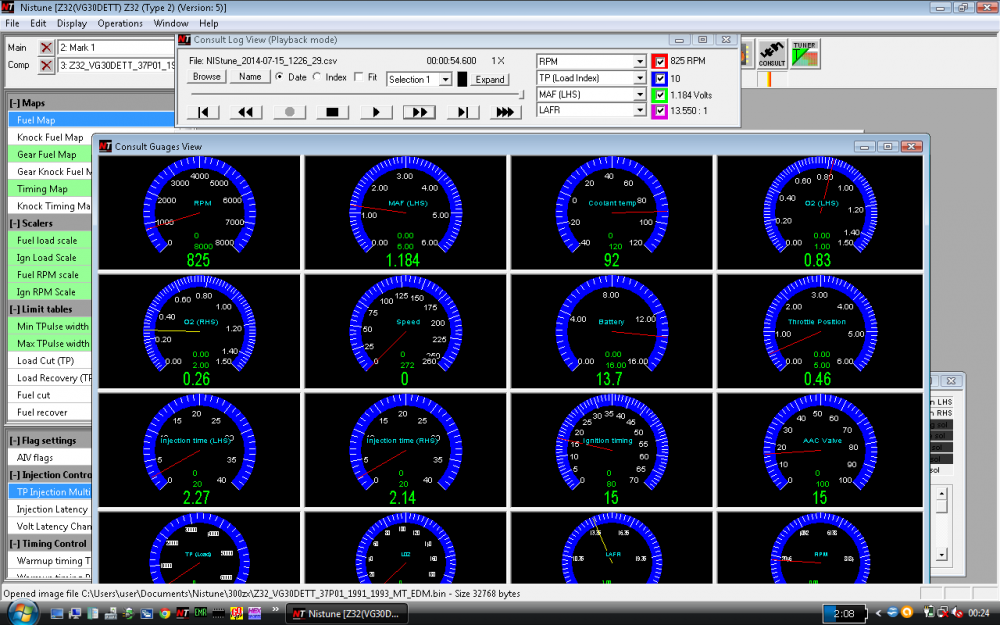
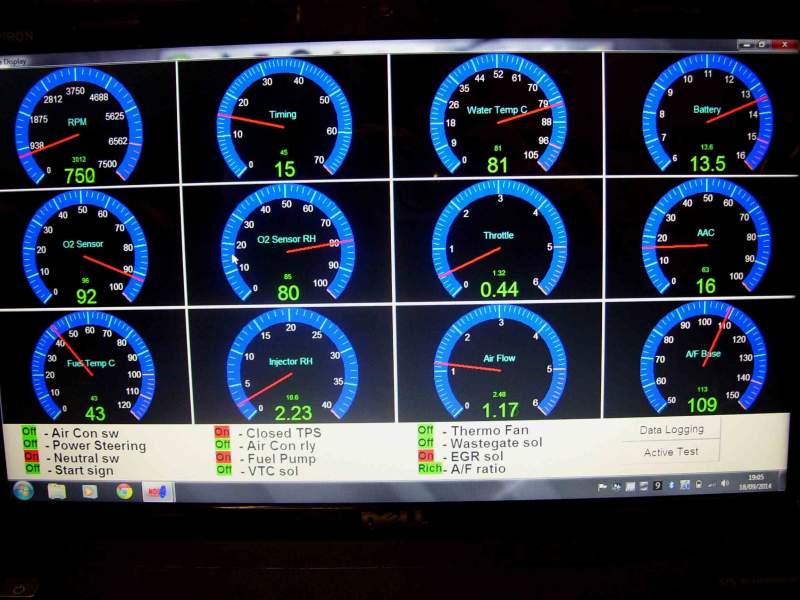
This is what I recorded yesterday using ECUtalk. I edited the video down to 4:15, just from the time I got on the interstate and exited again.


Apologies for all the clicking picked up by the microphone, the only thing I can think is it was rubbing on the leather seat?


I think everything looks normal. Car did not go into safety boost, which is what I was hoping I would get so I could record what the engine was doing when it occurs. My theory of a faulty MAF seems to be disproved by this recording, at 6,000 rpm with 3.26 volts on the throttle (and about 10.5 psi boost) the MAF was at 4.16 v (this is at approx. 110 mph, in 3rd gear- automatic transmission). However, the MAF was showing a bad reading with the ignition ON (engine not running) of 0.44 with a voltmeter, ECUTalk recorded 0.08 volts. Service manual says it should be 0.8 volts.


ECUTalk could not read the speed, I believe the consult adapter I got on Ebay is faulty. It also causes a code 14 Speed sensor fault, and sets off the HICAS warning light, and to make things just peachy it puts the power steering into "high speed mode"- fine for the freeway, not so great on city streets. Removing the consult adapter from the vehicle's plug restores everything to normal. So I am asking the seller for a replacement adapter, assuming this one has some kind of internal short.


Also did a power balance test when I got home using OBD Scantech. Got an rpm drop on every cylinder, so presuming I have no misfires (at idle anyway). Is it worth re-running the balance test at higher rpm (I saw that as an option)?


Power Balance Test Summary On 9/13/2014 5:08:33 PM

Coolant Temperature: 189 Deg {F}

Idle Air: 24 %


Cylinder # 1

Cylinder On Stablized For 2 Seconds

Average RPM When Cylinder Stablized... 845 Rpm

Cylinder Off Sampled For 3 Seconds

Average RPM When Cylinder Is Off... 802 Rpm

Average RPM Drop Result... 43 Rpm

Highest RPM Drop... 95 Rpm

Amount Of Data Sampled When Cylinder Off... 182


Cylinder # 2

Cylinder On Stablized For 2 Seconds

Average RPM When Cylinder Stablized... 869 Rpm

Cylinder Off Sampled For 3 Seconds

Average RPM When Cylinder Is Off... 827 Rpm

Average RPM Drop Result... 42 Rpm

Highest RPM Drop... 69 Rpm

Amount Of Data Sampled When Cylinder Off... 187


Cylinder # 3

Cylinder On Stablized For 2 Seconds

Average RPM When Cylinder Stablized... 877 Rpm

Cylinder Off Sampled For 3 Seconds

Average RPM When Cylinder Is Off... 817 Rpm

Average RPM Drop Result... 60 Rpm

Highest RPM Drop... 114 Rpm

Amount Of Data Sampled When Cylinder Off... 191


Cylinder # 4

Cylinder On Stablized For 2 Seconds

Average RPM When Cylinder Stablized... 873 Rpm

Cylinder Off Sampled For 3 Seconds

Average RPM When Cylinder Is Off... 815 Rpm

Average RPM Drop Result... 58 Rpm

Highest RPM Drop... 110 Rpm

Amount Of Data Sampled When Cylinder Off... 186


Cylinder # 5

Cylinder On Stablized For 2 Seconds

Average RPM When Cylinder Stablized... 864 Rpm

Cylinder Off Sampled For 3 Seconds

Average RPM When Cylinder Is Off... 817 Rpm

Average RPM Drop Result... 47 Rpm

Highest RPM Drop... 76 Rpm

Amount Of Data Sampled When Cylinder Off... 185


Cylinder # 6

Cylinder On Stablized For 2 Seconds

Average RPM When Cylinder Stablized... 869 Rpm

Cylinder Off Sampled For 3 Seconds

Average RPM When Cylinder Is Off... 817 Rpm

Average RPM Drop Result... 52 Rpm

Highest RPM Drop... 106 Rpm

Amount Of Data Sampled When Cylinder Off... 186


Can anyone tell me if this is all normal?


Thanks,


Mark

(Crossposted to every 300zx forum I am a member of)

  • Replies 80
  • Views 6.2k
  • Created
  • Last Reply

Top Posters In This Topic

Posted Images

Featured Replies

It may be me, but could not see any correlation between the TPS voltage and the RPM.

Unless I am mistaken, at one point you had .46v at idle and again .46v at 3000RPM

maybe I need to watch it again.

Interesting though.

  • Author

I remember that part of the recording, I took my foot off the gas (technically throttle was at idle) to slow down as I was catching up to traffic (happens quickly when I am doing 115+ mph and they are doing 75).


Apparently the better correlation is throttle voltage and airflow. Here is a graph of RPM, throttle position and airflow. Time is first 1:52 of the of the youtube video. One thing I learned from graphing it was that there is a lot of shakiness in the airflow, especially at closed throttle. That indicates vacuum leaks. And I thought I was on top of them...


plot1.png

I've not watched the video, but you need to wind the IACV screw out a bit, it should be reading 15% on idle with all accessories switched off.

  • Author
I've not watched the video, but you need to wind the IACV screw out a bit, it should be reading 15% on idle with all accessories switched off.


I thought it looked a little high, then I found this on the Z32 Wiki-


"...generally, when warm, the duty cycle is around 30%. If the number is 15% or lower, this often means a vacuum leak is present, as 15% is the lower threshold of the AACs operation, and this indicates the ECU attempting to lower the idle speed."


http://z32.wikispaces.com/Consult+Quick+Reference


It was the only reference I could find to what the AAC duty cycle should be.

I've never seen it lower than 15%.


Here's some more info from a post I made a while ago:


I never set it that way on a Zed, the less the loom is disturbed around that area the better for me.


By setting it initially via diagnostics, you just monitor how quickly the AAC % reaches the desired 15%. This way, you simply set it so it just drops to 15% after manually increasing the revs and letting them settle. The whole 650rpm on the tacho is probably just to ensure the AAC% will be >15% once the plug is reconnected. Kind of pointless really, but perfectly understandable in the days when diagnostic machines were main dealer only. Naturally, all this needs to be done when the car is up to temp and with all ancillaries switched off. The main thing is that the AAC just hits 15% at the desired idle RPM. If the rate of decrease is too high, the valve is too far open. Takes all of 3 minutes to get it spot-on and no messing around with connectors & clips :D


Couple of side notes:

AAC minimum on my own car is 17%, it never reaches 15% anymore.

For Auto-Manual converted cars, I always use a manual configuration file when mapping so as to avoid the +10° timing increase (idle & in gear condition) when the neutral switch has not been wired in. Idle RPM will increase if you're still using an Auto ECU and no neutral switch.


Hope that helps.

I remember that part of the recording, I took my foot off the gas (technically throttle was at idle) to slow down as I was catching up to traffic (happens quickly when I am doing 115+ mph and they are doing 75).


Apparently the better correlation is throttle voltage and airflow. Here is a graph of RPM, throttle position and airflow. Time is first 1:52 of the of the youtube video. One thing I learned from graphing it was that there is a lot of shakiness in the airflow, especially at closed throttle. That indicates vacuum leaks. And I thought I was on top of them...


plot1.png


I understand it now, obvious to me now you have explained it. Brilliant.


As for AAC, mine settles at 15% when up to temperature. Could this mean I have a vacuum leak then?

I have often doubted my zeds performance.

I understand it now, obvious to me now you have explained it. Brilliant.


As for AAC, mine settles at 15% when up to temperature. Could this mean I have a vacuum leak then?

I have often doubted my zeds performance.


:blink:


No. It doesn't mean that in the slightest. Read post 6 :laugh:


30% at warm idle means the IACV is working too hard to maintain the designated idle speed. I don't care what Z32wiki says, that is plain incorrect in practice. Unless you enjoy revs dropping low at every junction :wack:


15%


15%


15%


In case there is any uncertainty....


15%

:blink:


No. It doesn't mean that in the slightest. Read post 6 :laugh:


30% at warm idle means the IACV is working too hard to maintain the designated idle speed. I don't care what Z32wiki says, that is plain incorrect in practice. Unless you enjoy revs dropping low at every junction :wack:


15%


15%


15%


In case there is any uncertainty....


15%


Haha haha


16% brilliant

:blink:


No. It doesn't mean that in the slightest. Read post 6 :laugh:


30% at warm idle means the IACV is working too hard to maintain the designated idle speed. I don't care what Z32wiki says, that is plain incorrect in practice. Unless you enjoy revs dropping low at every junction :wack:


15%


15%


15%


In case there is any uncertainty....


15%


Just thought I would ask the question as there was conflicting statements.

That's me told. :lol::lol:

Just thought I would ask the question as there was conflicting statements.

That's me told. :lol::lol:


:thumbup:


You may have a vacuum leak, but that is separate from IACV setup. Perform a boost leak test. Then after any issues are resolved, recheck the IACV value & operation :)

The manuals are a good set of instructions for a brand new completely stock 300ZX, but when it comes to a car that is 20+ years old and more than likely different to factory spec, they are simply a guideline.


EF & EC-38


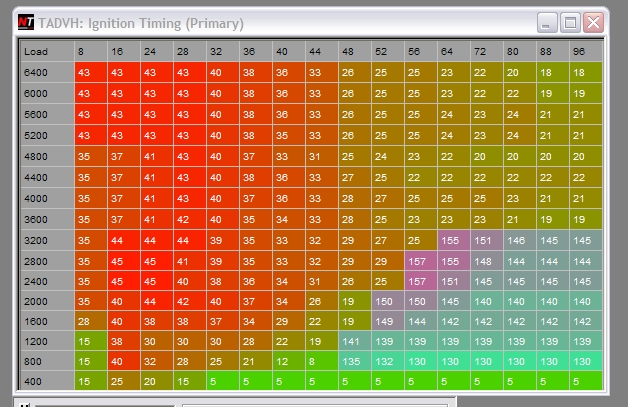
Idle timing 15°±2°. Nope, 15°±0°. It is imperative base timing is set at 15°. If you can't get it exactly on the 15° mark, make sure it sits just to the right, ie less than 15° and slightly retarded. Never higher, not on these cars, not in this country.


AAC valve 15 - 40% (NA); 15 - 35% (Turbo). Nope, 15%. See post 6. Every Zed that needs the idle setting up I set it to 15%. I could set it to any %, but I always, without fail, set it to 15% for the specified target idle RPM. They idle perfectly like this, it is not a brand new component. No need to unplug the AAC valve, disrupting a 20+ year old wiring loom is a bad idea.

Douglas Adams was wrong. The answer is 15.

Any man who thinks the answer the universe and everything is a number is wrong. The actual answer is simply.........


why the hell not??

Noel, so do you think it's best to set the idle without unplugging the AAC? I always thought you were meant to.


Ill have a look at mine in the next couple of days to see what the idle's reading at.

Membership No 0780

INSURANCE GOOFA

Datascan, Conzult, ECUTalk and a few others

I have all the rare bits you can't find :tongue::tongue:


Noel, so do you think it's best to set the idle without unplugging the AAC? I always thought you were meant to.


I never set it that way on a Zed, the less the loom is disturbed around that area the better for me.


By setting it initially via diagnostics, you just monitor how quickly the AAC % reaches the desired 15%. This way, you simply set it so it just drops to 15% after manually increasing the revs and letting them settle. The whole 650rpm on the tacho is probably just to ensure the AAC% will be >15% once the plug is reconnected. Kind of pointless really, but perfectly understandable in the days when diagnostic machines were main dealer only. Naturally, all this needs to be done when the car is up to temp and with all ancillaries switched off. The main thing is that the AAC just hits 15% at the desired idle RPM. If the rate of decrease is too high, the valve is too far open. Takes all of 3 minutes to get it spot-on and no messing around with connectors & clips


Couple of side notes:

AAC minimum on my own car is 17%, it never reaches 15% anymore.

For Auto-Manual converted cars, I always use a manual configuration file when mapping so as to avoid the +10° timing increase (idle & in gear condition) when the neutral switch has not been wired in. Idle RPM will increase if you're still using an Auto ECU and no neutral switch.


writing_process.gif


^^This is me right now. Look what you've done :wack:

What I mean is why does everything say you should remove the AAC when you don't need to?

Membership No 0780

INSURANCE GOOFA

Datascan, Conzult, ECUTalk and a few others

I have all the rare bits you can't find :tongue::tongue:


What I mean is why does everything say you should remove the AAC when you don't need to?


I never set it that way on a Zed, the less the loom is disturbed around that area the better for me.


By setting it initially via diagnostics, you just monitor how quickly the AAC % reaches the desired 15%. This way, you simply set it so it just drops to 15% after manually increasing the revs and letting them settle. The whole 650rpm on the tacho is probably just to ensure the AAC% will be >15% once the plug is reconnected. Kind of pointless really, but perfectly understandable in the days when diagnostic machines were main dealer only. Naturally, all this needs to be done when the car is up to temp and with all ancillaries switched off. The main thing is that the AAC just hits 15% at the desired idle RPM. If the rate of decrease is too high, the valve is too far open. Takes all of 3 minutes to get it spot-on and no messing around with connectors & clips


Couple of side notes:

AAC minimum on my own car is 17%, it never reaches 15% anymore.

For Auto-Manual converted cars, I always use a manual configuration file when mapping so as to avoid the +10° timing increase (idle & in gear condition) when the neutral switch has not been wired in. Idle RPM will increase if you're still using an Auto ECU and no neutral switch.


:kiss:

Real readings from stock NA auto this am

When cold: AAC 80, 1250 rpm

within a few secs: AAC 54, 1200 rpm

after 6 miles: AAC 34 in the instant after shifting into N which then sank within a sec or so to 15 and 810 - 850 rpm

AFM @ 1.23 at warm idle

It's noticable that sometimes it idles at 850 - 810 and sometimes it drops to 750 - maybe it takes time to settle.


But in any case, the guy's (I usually rtfq as well as rtfm) q was does this all look normal. So was his 24% after he'd let it settle to steady idle (in which case it's too high according to some but within the manual limits) or while it was just on the way down (in which case what was his steady idle AAC).

The rest of it I wouldn't dare comment on without rtfm.


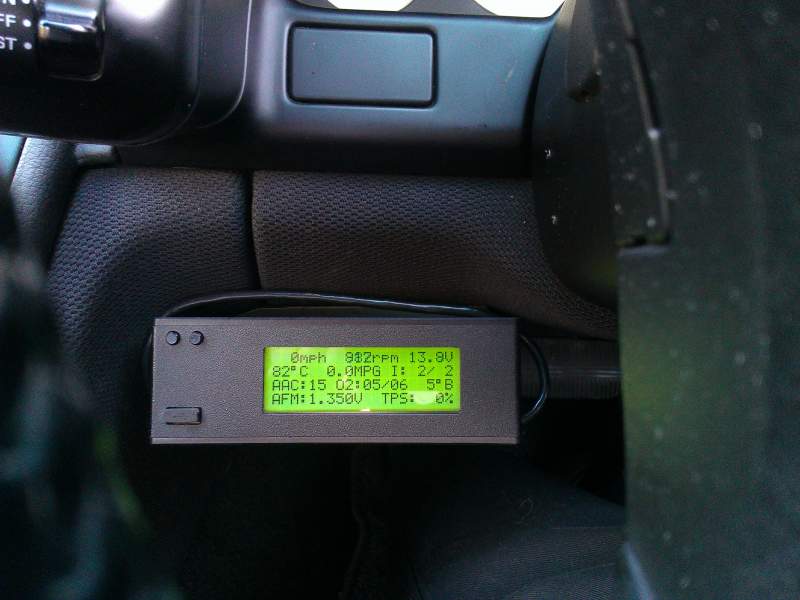
@madkiwi Have you looked at the diag codes and seen if the safety boost / knock sensor has happened / is happening? Also my ECUTalk (which is the fully-built version) does not mess with the speed sensor / HICAS / power steering thing so I think your assumption that the consult adapter is faulty is probably correct.

WP_000357.jpg

  • Author
Real readings from stock NA auto this am

When cold: AAC 80, 1250 rpm

within a few secs: AAC 54, 1200 rpm

after 6 miles: AAC 34 in the instant after shifting into N which then sank within a sec or so to 15 and 810 - 850 rpm

AFM @ 1.23 at warm idle

It's noticable that sometimes it idles at 850 - 810 and sometimes it drops to 750 - maybe it takes time to settle.


But in any case, the guy's (I usually rtfq as well as rtfm) q was does this all look normal. So was his 24% after he'd let it settle to steady idle (in which case it's too high according to some but within the manual limits) or while it was just on the way down (in which case what was his steady idle AAC).

The rest of it I wouldn't dare comment on without rtfm.


@madkiwi Have you looked at the diag codes and seen if the safety boost / knock sensor has happened / is happening? Also my ECUTalk (which is the fully-built version) does not mess with the speed sensor / HICAS / power steering thing so I think your assumption that the consult adapter is faulty is probably correct.

[ATTACH=CONFIG]82883[/ATTACH]


I realized later that the 24% from the AAC was during the cylinder drop test. The software (OBD Scantech) actually increased the rpms before the test started to 850 from my normal idle of 750 (actually from my recordings it wobbles around from 737 to 762). Point is, the 24% is not my normal idle number. I have not had a chance to check what it actually is, in between work and wondering if the Ebay seller is going to replace the Consult tool I have not had the time.


Plus yesterday when I thought I may get a chance, I decided to install my new cooling fan and fan clutch. That took longer than I thought, and I ran out of my allotted time to run the Consult again...


The fan had some pretty good cracks in the hub-


fan1.jpg


but the primary reason for replacement was because the clutch had the same amount of rotational resistance hot or cold so I was pretty sure it was not functioning correctly after 21 years.


I also found one of the recirc hose clamps was completely loose! When I replaced the recirc valve a couple weeks ago, and changed all the hoses to silicone, I missed one of the clamps. That may explain my lack of boost...


When the car goes into safety boost no codes are generated. Because everything is functioning normally. I have no knock sensor code, because my knock sensor is working, you only get a code when the ECU cannot communicate with it.


I have been in email contact with Peter Collins, the author of ECUtalk (as I guess you know having purchased one of his LCD displays) and he is pretty sure the Consult adapter is causing the issue. Pretty obvious really, the problems happen even if it is not plugged into the computer...


I will try to get some time today to plug the computer into the car again and figure out what is my AAC duty cycle actually is at idle.

  • Author

Back to my problem now...


I just noticed something on my graph that makes me think.


Between 22.10.5 and 22.17.1 (6.5 seconds elapsed) RPMs increased from 4650 to 5912. That is an increase of 27.13% In the same timespan MAF voltage increased from 3.29 V to 4.16 V, only a 6.12% increase. Considering the engine is just a big air pump, if the engine is running 27% faster shouldn't the air going through it also increase by 27%?


This presumes the MAF sensor voltage output is linear, which I believe it is supposed to be.


This would explain my high boost detonation. The ECU is not receiving the full story on how much air is going through, and is supplying fuel at the incorrect ratio- leading to a lean condition.


Am I smoking crack here?


Am I smoking crack here?


Well, I wouldn't put it that way exactly!


MAF voltage output is not linear. It shares a polynomial relationship with the mass of air flowing through it.


4.16v is about right for 10.5psi* at 6k RPM under full load. I know this due to the thousands of log files I have recorded whilst mapping many Zeds both on the road and on the dyno. (Just in case anyone suggest I RTFM.... I already did ;))


*Edit: on stock turbos

Edited by Noz

Join the conversation

You can post now and register later. If you have an account, sign in now to post with your account.

Guest
Unfortunately, your content contains terms that we do not allow. Please edit your content to remove the highlighted words below.
Reply to this topic...

Recently Browsing 0

  • No registered users viewing this page.

Important Information

Terms of Use

Configure browser push notifications

Chrome (Android)
  1. Tap the lock icon next to the address bar.
  2. Tap Permissions → Notifications.
  3. Adjust your preference.
Chrome (Desktop)
  1. Click the padlock icon in the address bar.
  2. Select Site settings.
  3. Find Notifications and adjust your preference.