
Jump to content
View in the app

A better way to browse. Learn more.

300ZX Owners Club

A full-screen app on your home screen with push notifications, badges and more.

To install this app on iOS and iPadOS
  1. Tap the Share icon in Safari
  2. Scroll the menu and tap Add to Home Screen.
  3. Tap Add in the top-right corner.
To install this app on Android
  1. Tap the 3-dot menu (⋮) in the top-right corner of the browser.
  2. Tap Add to Home screen or Install app.
  3. Confirm by tapping Install.

I have now installed two blitz bov's on my z.


The problem is throttle a now not as smooth as it was with the recircs. For example if I plant my foot and build boost only to about 5psi and slowly release the throttle the car jerks. I assume this is because of the measured air isn't being matched by actual air, correct?


Others with bov's must have experienced this? I am planning on having the car mapped soon on a rolling road, will this eradicate the problem?


Thanks, Dan

  • Replies 59
  • Views 2.9k
  • Created
  • Last Reply

Top Posters In This Topic

Posted Images

Featured Replies

I don't know the perfect terminology for these things, I thought stall was misleading because it makes people think that you are stopping your turbo when you're just slowing it down a bit, and chopping up some air going backwards down a one way pipe. it's just we call it compressor surge when it happens on a Sea King engine. And when it does it's like that video above of "true" compressor surge.


People also call the same noise (surge) wastegate chatter don't they, but waste gates don't make any sound do they? Unless you have a screamer pipe which I understand to be tapped off exhaust gas that normally just bypasses the power turbine and re enters the exhaust behind it, but in the case of a screamer pipe shrieks out to atmosphere? Which isn't really wastegate noise either just something vaguely associated with the wastegate.


And when you shut a Gnome engine down you get the ultimate Scania Air brakes noise :lol:

  • Author
With the GHK fitted, compressed air being suddenly released back into the inlet track.


Compressor surge = uncontrollable turbine overrun. Example video:


[video=youtube_share;nCj6Spwl1CU]


Compressor stall = back pressure through compressor turbine when throttle is closed from WOT.


The stock recircs are primarily there to prevent compressor stall and so improve drivability:


http://www.twinturbo.net/nissan/300zx/FAQ/FAQpages/bov.html


By the way read "stall" for "surge" in the FAQ!


When you say the ghk forces air back into the inlet track thus creating the noise (I assume this is what you mean) the noise surely is the air being chopped by the turbo blades, as the ghk has a stronger tension spring??

I don't know the perfect terminology for these things, I thought stall was misleading because it makes people think that you are stopping your turbo when you're just slowing it down a bit, and chopping up some air going backwards down a one way pipe. it's just we call it compressor surge when it happens on a Sea King engine. And when it does it's like that video above of "true" compressor surge.


People also call the same noise (surge) wastegate chatter don't they, but waste gates don't make any sound do they? Unless you have a screamer pipe which I understand to be tapped off exhaust gas that normally just bypasses the power turbine and re enters the exhaust behind it, but in the case of a screamer pipe shrieks out to atmosphere? Which isn't really wastegate noise either just something vaguely associated with the wastegate.


And when you shut a Gnome engine down you get the ultimate Scania Air brakes noise :lol:


Tom, it seems to me that "surge" and "stall" are interchanged. It would be interesting to know what your technicians would call the

phenomena with the Z32 throttle closed from WOT and the turbine slowing down rapidly as a result (if there were no recircs/bovs).


What happens with a Gnome engine during shutdown - does the compressor continue to run and therefore require venting?


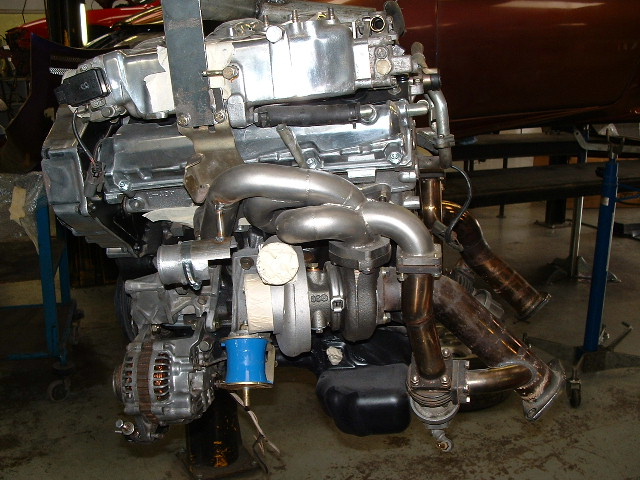
Here is a Greddy/Pentroof setup with an external wastegate, in this case the wastegate exhaust has been redirected back into

the main exhaust (for noise reasons). Otherwise, the wastegate would vent to atmosphere with the "screamer" sound. Some

of you may recognise the engine.


mac012.jpg

Project 1547 - Out of the Blue

She's so fine, there's no tellin' where the money went - Simply irresistible.

When you say the ghk forces air back into the inlet track thus creating the noise (I assume this is what you mean) the noise surely is the air being chopped by the turbo blades, as the ghk has a stronger tension spring??


Danny, before I fitted the GHK there was very noticeable GH with the Selin dual maf setup (there was no Pssst noise that I could hear)

With the GHK fitted, the Pssst noise became quite noticeable. The stonger springs in the GHK make the recircs operate under higher vacuum

conditions than before, but it still operates as a recirc to divert excess pressure and stop the turbine stalling. Reading through the

information on the BDE site on recircs and how the GHK works, I took the pssst to be happening because the recirc was opening later

and therefore dumping compressed air more aggressively. Of course I could be wrong, here are the links:


http://bde-performance.com/goose.htm (what the stiffer GHK springs do)


and


http://bde-performance.com/goose_how.htm (how recircs work)

Project 1547 - Out of the Blue

She's so fine, there's no tellin' where the money went - Simply irresistible.

Paul ZX put a group order in, but I think he did yeah. Andrew I agree with everything you have said. My honk came on after fitting my Selin Dual MAF and I thought I had created a boost leak at first it was so loud. I suppose it was just more audible after the mod.


I will ask some Pilots and Engineers what they would call it. And when you shut down a Gnome engine there is no atmospheric vent system on it, but there is a definite harsh "kssssskhhh" rather than a softer "Psssst" Most engine failures it's the first thing you notice before the drop in power and floating about down the cabin starts. I think it is simply because it's quite a big cylinder full of compressed air and it comes out front and back when it runs down. I will pay close attention next time I am outside the aircraft when it shuts down and listen for any chirruping through the blades.

Tom, it seems to me that "surge" and "stall" are interchanged. It would be interesting to know what your technicians would call the

phenomena with the Z32 throttle closed from WOT and the turbine slowing down rapidly as a result (if there were no recircs/bovs).


What happens with a Gnome engine during shutdown - does the compressor continue to run and therefore require venting?


Here is a Greddy/Pentroof setup with an external wastegate, in this case the wastegate exhaust has been redirected back into

the main exhaust (for noise reasons). Otherwise, the wastegate would vent to atmosphere with the "screamer" sound. Some

of you may recognise the engine.


[ATTACH=CONFIG]80393[/ATTACH]


Paul ZX put a group order in, but I think he did yeah. Andrew I agree with everything you have said. My honk came on after fitting my Selin Dual MAF and I thought I had created a boost leak at first it was so loud. I suppose it was just more audible after the mod.


I will ask some Pilots and Engineers what they would call it. And when you shut down a Gnome engine there is no atmospheric vent system on it, but there is a definite harsh "kssssskhhh" rather than a softer "Psssst" Most engine failures it's the first thing you notice before the drop in power and floating about down the cabin starts. I think it is simply because it's quite a big cylinder full of compressed air and it comes out front and back when it runs down. I will pay close attention next time I am outside the aircraft when it shuts down and listen for any chirruping through the blades.


My experience is mainly based around high bypass turbo fan gas turbines and although the Gnome is a free-power turbine, the other basic principles of the engines remain.

When you shutdown the engine, the fuel is immediately isolated into the combustion chambers, the angle of the compressor blades will go towards the closed position and a series of bleed valves will go towards the open position. These are part of the surge control systems (amongst others) to prevent surge during shutdown or at any point whilst the engine is running. The loud 'air brake noise' you hear on shutdown is the bleed valves venting the compressed air to atmosphere after the compressor stage as the engine spools down.

In an axial flow compressor (such as the Gnome or what I work on), stall would be when the airflow is disturbed in only a small portion of the compressor (maybe one or part of a stage), whereas surge is when all stages of the compressor stall. A turbocharger has a single stage centrifugal compressor so stall and surge can generally be considered the same thing.

Joel :bow: I only learn this stuff for a few days a year for my annual check, I then dump it all again to make sure I remember that cpr is 30:2 and anyone over 22 stone you winch the helicopter down rather than them up!

Join the conversation

You can post now and register later. If you have an account, sign in now to post with your account.

Guest
Unfortunately, your content contains terms that we do not allow. Please edit your content to remove the highlighted words below.
Reply to this topic...

Recently Browsing 0

  • No registered users viewing this page.

Important Information

Terms of Use

Configure browser push notifications

Chrome (Android)
  1. Tap the lock icon next to the address bar.
  2. Tap Permissions → Notifications.
  3. Adjust your preference.
Chrome (Desktop)
  1. Click the padlock icon in the address bar.
  2. Select Site settings.
  3. Find Notifications and adjust your preference.