
Jump to content
View in the app

A better way to browse. Learn more.

300ZX Owners Club

A full-screen app on your home screen with push notifications, badges and more.

To install this app on iOS and iPadOS
  1. Tap the Share icon in Safari
  2. Scroll the menu and tap Add to Home Screen.
  3. Tap Add in the top-right corner.
To install this app on Android
  1. Tap the 3-dot menu (⋮) in the top-right corner of the browser.
  2. Tap Add to Home screen or Install app.
  3. Confirm by tapping Install.

Just to start with can we stick to combined pressure or it just gets confusing.


So is 20-22psi ok on stock setup?


Because in a few weeks that's what I'll have. I've done my research and most say that after 28psi you need to seriously start thinking about internals.


So I thought a 3-4 psi increase each turbo wasn't over the top. But should give me that little extra kick. And I was just wondering what other people where running.


Before anyone asks one of my turbos is shot and while I was changing them I thought I might as well do a few mods and get a little more power.


I should be getting 400bhp @ flywheel at this pressure . . . if my maths is right :tongue_smilie:

  • Replies 162
  • Views 32k
  • Created
  • Last Reply

Top Posters In This Topic

Most Popular Posts

  • Dude stock tubs dont run 21psi,i dont care what your claiming in aint happening,heat soak and impeller size permits this,its not possible.Im running gt525 turbos which run the largest impeller you can

Posted Images

Featured Replies

Standard Boost is 9.5 PSI ,some ZX's were fitted with ceramic turbo rotors [my friend had ceramic rotors in his standard Auto TT from the factory when it was new there was not many like this]simular to the SKyline rotors which the advice is not to boost over 12PSI. To be safe you should change the ECU ROM Chip if you boost over 12PSI.and the injectors over 22PSI. runnig on 98 octane fuel. You would will start to max out at about 24PSI. on standard manual turbos.

As far as I'm aware, the 300ZX was only ever fitted with two types of turbos: steel-wheeled TB02/TB22 turbine housing A/R .63 on the manuals and steel-wheeled TB02/TB22 turbine housing A/R .54 on the Autos.


Here is the compressor map for the stock 300ZX Garrett turbochargers:


503908-1.gif


According to Garrett themselves: maximum boost occurs at a pressure ratio, P2C/P1C = 2.75.


(2.75-1) x 14.7 = 25.725 psi or 1.75 bar


With the number-crunching already done, (I'll assume it's correct):


300zxCompressorMap.jpg


This backs up everything posted in this thread with regards to running 21 psi. At 7k RPM, the turbos will be flowing around 1 bar as was observed


Airflow = BHP*AFR*BSFC/60. For 400bhp you need approximately 44lb/min airflow, with an assumed BSFC of 0.55 at all engine RPM & AFR of 12:1. I hit near enough that (394.4bhp) at 5800 RPM. Looking at the graph, this corresponds roughly to 1.2 bar and 23lb/min (46lb/min in twin turbo configuration).


So there you have it. Empirical data & theoretical data working in unison. There should not be any doubts left as to whether or not you can run 21 psi on stock turbos if you wish to. No reason why it can't be perfectly relaible as long as the mapping is spot on, bearing in mind the increased wear on the turbochargers themselves.


Stating that above xx psi the turbos "just blow hot air" isn't very accurate either.


If I hadn't observed the above for myself, I probably would have searched out the compressor map first....


Running maximum boost pressure of 1.7 bar for the mid range would probably see you with 450lbft around 4400 RPM. Assuming max BHP is attained

very very interesting :cool3:


could you pm me what the average cost of a remap would be :)

the Ceramic Comp wheels was only fitted to some of the Early s13/s14 cars .. and do share the same tub Housings as the 300z ( T2-25 ) tub

but thats about it

Non of the 300z had this type of turbo .. they may have been swapped at some point for s13/s14tubs

and as u say ceramic comp wheels are well known for exploding on boosts of 20psi more

All S-bodies had steel-wheeled turbos.


S13 CA18DET: T25

S13 SR20DET: T25G

S14 & S14a: T28

S15: T28 BB


The only Nissans that rocked ceramics were Skylines (that I can think of right now). The wheels make a bid for freedom at anything approaching 1 bar, typically.

I do recall reading that the earlier R32 Skyline GTR's were fitted with ceramic turbines with the exception of those fitted with the N1 engine. I believe (though could be mistaken) that the R33 and R34 had the same steel turbines, not sure on the 'S' bodies though?

Yep it was only the s1 skyline engines that ran ceramic turbos I had one on my r33 rb25det engine crap turbos lol

Edited by 111mattin111

R33 Gtr Has ceramics as well ive replace a few on customer cars to gt2860r 's after the exhaust wheels have fell of at 1 bar


uk r33gtrs however had steels i used to work for nissan ;)

I'm pretty sure every Skyline apart from special editions ran turbos with ceramic turbine wheels, including all R32-R34 GTRs & GTSts, RB20, RB25 & RB26. R34 GTRs had ball bearing ceramic-wheeled turbos.


I can't remember if all UK R33 GTRs were just V-Specs or others made it over as well. I know they were imported by Middlehurst and modified in various ways. More like a UK-Spec R33 than true UK car IMO.


100% that S-body turbos were all steel. S13 T25 comp was .48, turbine .64 (I've got one here in front of me, piddly little thing). IIRC, S13 T25Gs had a .80 comp housing. S14-S15 T28s had .60 comp & .64 turbine housings.

Edited by Noz

oHH, one month ago I tried to plot the rpm straigh lines into a turbo graph, but finallly, I made the data with error...


Could you tell me what equations and values do you use?


Here to help as always. Plus I'm a geek :online2long:


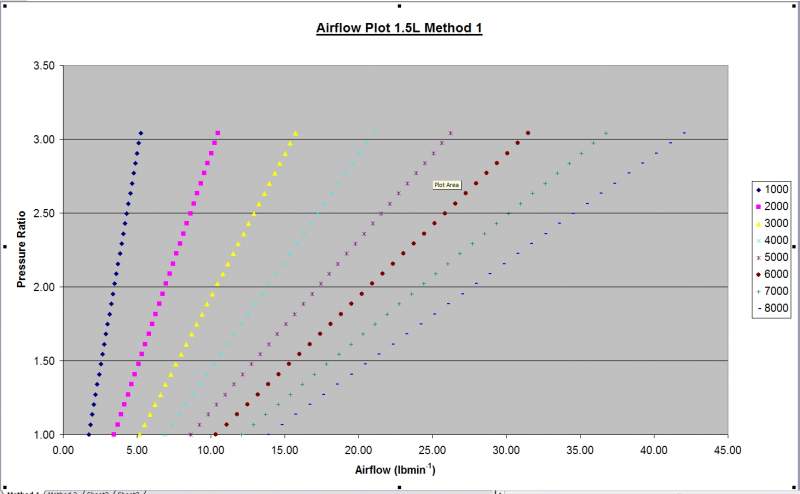
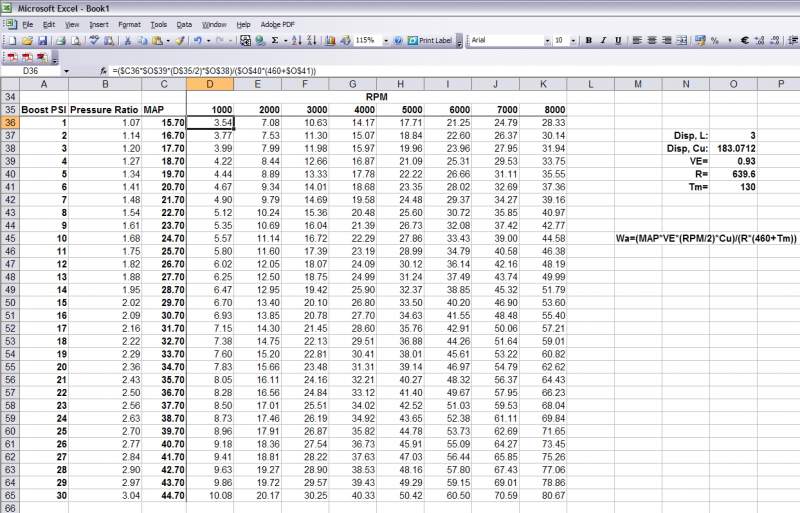
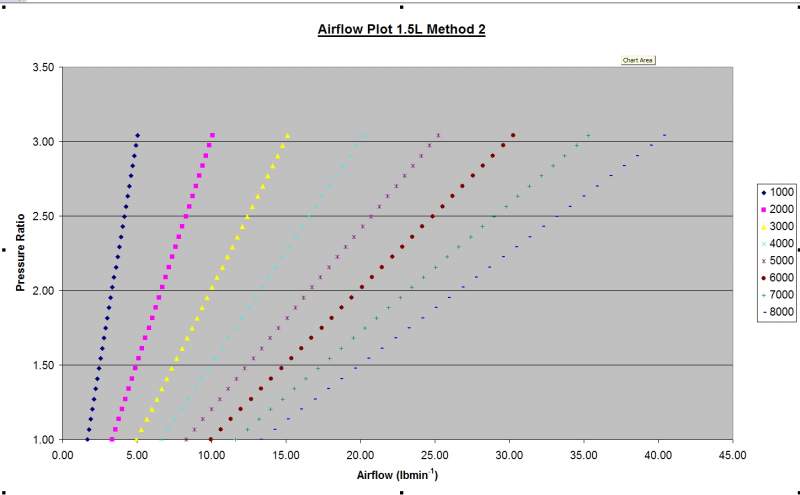
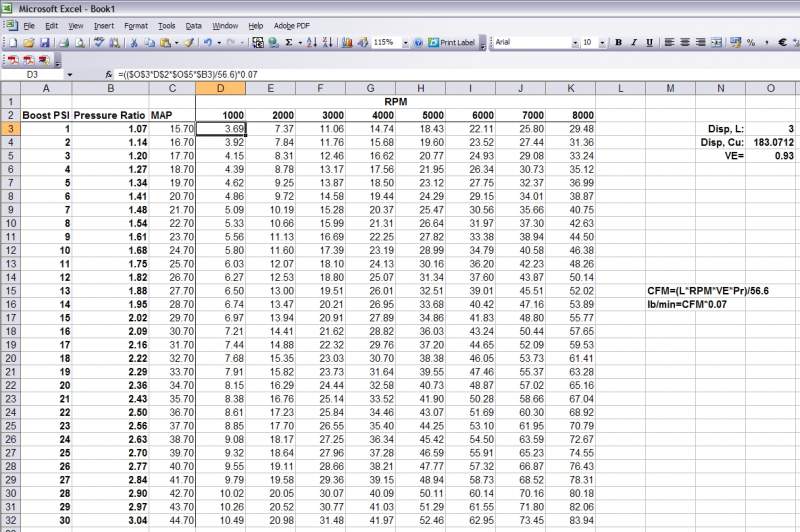
Please note that the spreadsheets show the airflow requirements of a 3.0L engine, whereas the data plots are simply halved for a 1.5L engine (i.e. specifically for use with compressor maps for our twin-turbo set up).


Volumetric Efficiency (VE) can be calculated for your own engine from data logs, where VE=(Mass Air Flow x Air Temp)/(RPM x Air Pressure). It is a parameter that varies with RPM. Here it is assumed as a constant 93% for all engine speeds.

Air flow is measured in lb per min for these calcs, typically because that is the unit Garrett like to use. Elsewhere, CFM (Cubic Feet per Metre) is used regularly. lb/min = CFM x 0.07.

PR = Pressure ratio.


Method 1 uses calculations & assumptions from 'Forced Induction Performance Tuning' by A. Graham Bell:

Displacement is in Litres.


Airflow Calcs Method 1.jpg


Method 1 Data Plot:

Airflow Plot Method 1.jpg


Method 2 uses a more detailed calculation from the Garrett website:

VE = 93%

Displacement is in cu in = Litres x 61.02374.

R = Avogadros Gas Constant = 639.6 when using imperial measurements.

Tm = Intake temp, assumed to be 130° Fahrenheit.

MAP (Manifold Absolute Pressure) = psi + 14.7 (atmos).


Airflow Calcs Method 2.jpg


Method 2 Data Plot:

Airflow Plot Method 2.jpg


These calculations can be used in conjunction with BHP & boost requirement calculations to determine or assess the suitability of any engine/turbo combination. The results above differ from the plot I posted before, but they all give a good estimation.


Happpy boosting!!

Edited by Noz
typo

Join the conversation

You can post now and register later. If you have an account, sign in now to post with your account.

Guest
Unfortunately, your content contains terms that we do not allow. Please edit your content to remove the highlighted words below.
Reply to this topic...

Recently Browsing 0

  • No registered users viewing this page.

Important Information

Terms of Use

Configure browser push notifications

Chrome (Android)
  1. Tap the lock icon next to the address bar.
  2. Tap Permissions → Notifications.
  3. Adjust your preference.
Chrome (Desktop)
  1. Click the padlock icon in the address bar.
  2. Select Site settings.
  3. Find Notifications and adjust your preference.